More Tool Chest Storage Ideas

gradpasclosed

Anyone know where I can get a nice handle like his? Preferably in polished nickel? It’s basically a recessed pull like you’d find on a campaign chest, but with a place to put your fingers rather than a pull that lifts out. All the ones I’m seeing look kinda chintzy.

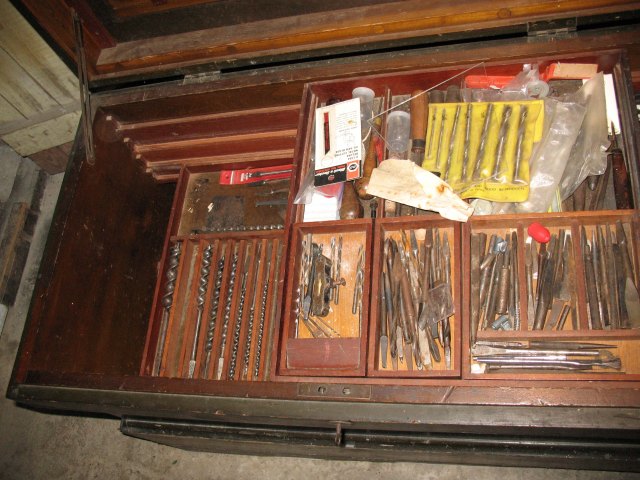
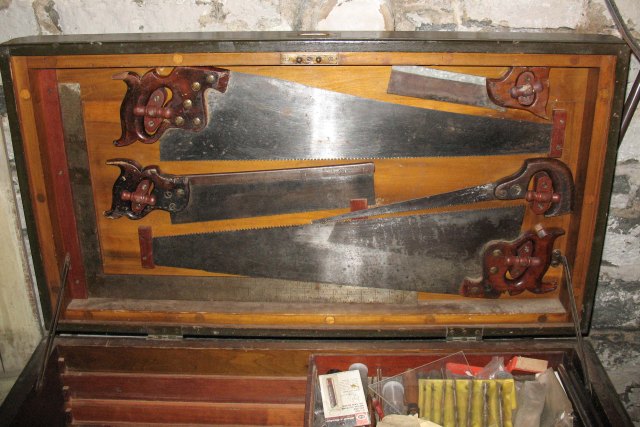
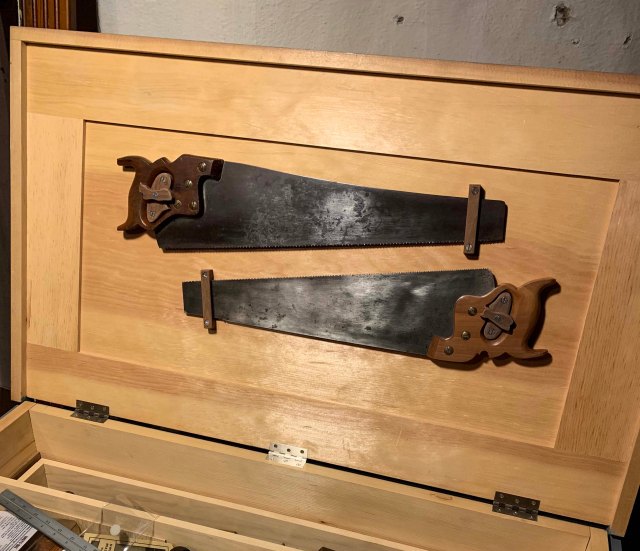
Someone on IG asked about storing backsaws in the lid of a tool chest, which immediately made me think of my grandfather’s chest – he had all his saws stored on the underside of the lid, which, like the “Anarchist’s Tool Chest,” has a raised-panel lid.

When I first started woodworking, I planned to someday have the skills to build a replica of his chest. I have built (more than once) what is pretty much the same carcase, but I changed my mind on the interior (for now, anyway).

I always admired his neatly organized trays of tools in four layers (some of the trays had their own trays, to boot!). They are about half as wide as the chest, and slide left and right to access the stuff underneath. But once I started actually working out of a tool chest, I realized it would be (to me) a bit of a pain to have to slide quite so many trays out of the way to get to stuff. (And a lot of pain to stay quite that organized.)

grandpasinterior

So instead, I’m going with three long trays (half the depth of the chest), and as I’ve mentioned ad nauseam, storing my backsaws behind the chisel rack (I worked on that today, so I’ll soon have a closer-to-finished interior to post). And in my new chest, I’m not storing full-sized handsaws/panel saws (though I’ve left enough space for that above the top till…just in case); I have only two that I’d want in my tool chest, and they will continue to live on the underside of my tool chest at home.

But my grandfather had five saws on his lid, held in place with toggles on keepers on the handle end, and supports on the business end of the long ones (plus a carpenter’s square). The dust seal on his lid is, however, deeper than what is on the ATC, to allow the handles to fit without crashing into the trays below. He built his as a high school project (a trade school where he learned cabinetmaking), so I’m reasonably certain this was the prescribed interior layout, or at least it was in Louisville in 1932.

Grandpaslid


Posted in Uncategorized | 8 Comments

Tools & Chest for Sale at LAP Saturday

tillslides

Maple till slides for my new ATC interior (you can see my final exterior paint job in the background).

If you follow me on Instagram, you know I’ve been putting finish on my new “Anarchist’s Tool Chest” for as many days as I spent making it. (Because I’m an idiot and didn’t test my topcoat, then had to strip it and repaint. Don’t be an idiot like me.) But I’m now (finally!) working on the interior, and will be transferring my tools from my old and smaller chest to the new one late Friday or early Saturday.

My old chest, which served me well for years at Popular Woodworking and more recently at Lost Art Press, has become too crowded now that I have the majority of my furniture-making kit at LAP instead of at home (plus doubles on some tools to loan to students). So the chest I’m finishing up now will replace my vintage one, and I’ll have it for sale this Saturday at the LAP open house (10 a.m.-5 p.m., 837 Willard St., Covington, Ky., 41011).

I bought the vintage chest (with one deep till and one shallow till) from Christopher Schwarz in 2007 or so, for $100 if I correctly recall, and I’m selling it for $80. The original owner’s stamp is on the front (but so is Chris’, and my name is on the interior – so it’s worth less now!), it has nice lifts, and I still have the key to the working lock. The great thing about this chest, unlike the ATC, is that it fits easily into the hatch or backseat of most cars.

oldchest

You can see my vintage chest – the one for sale – in the background to the left.

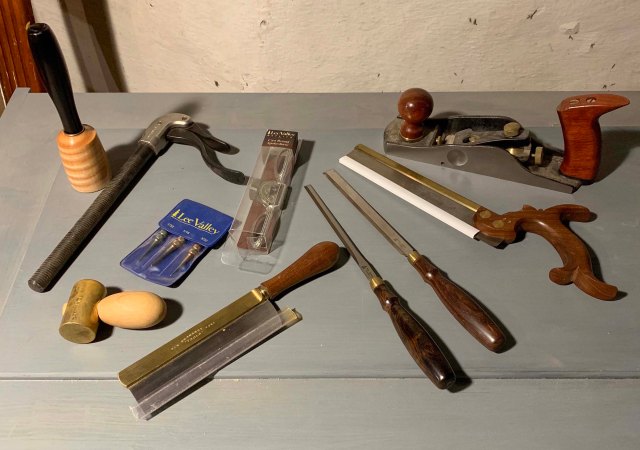
I’ll also have some perfectly good but superfluous-to-me tools (all of which are at least gently used) for sale – I’d rather they be used than gather dust in my basement (and OK…because I need to buy a band saw). Mostly, these are things I bought for magazine tool tests and didn’t actually need, or tools I once used and loved but have since replaced with tools I love more (what can I say – I’m fickle). So far (and there might be more – I’m still digging), these include: 13 ounce round mallet from Blue Spruce Toolworks ($55) (I prefer my 16 ounce one…probably because it’s blue); Veritas Fast-Action Hold-Down ($50); Glen-Drake Tite-Hammer #4 – 14 ounces ($45 – this one is well used; I used it for four years or so while chopping dovetails); Lee Valley nail set (set of three) ($10); Lee Valley Cast Round Spokeshave (a close copy of the Preston 1374 ($45); Gramercy Gent’s Saw (price TBD); two (3/8″ and 1/2″) Blue Spruce paring chisels ($55 each); Veritas Low-Angle Smooth Plane ($130); Gramercy dovetail saw ($100 – this is also well-used, by Chris, then by me…and I confess that it needs sharpening). Cash or check only…and only on site – but if after Saturday there is anything remaining, I’ll post it here.

Oh – and Chris is trying to convince me to sell my Lie-Nielsen No. 4 (I usually use my no. 3). It’s possible I might cave. But that bronze No. 4 is the first good plane I bought, I bought it directly from Thomas Lie-Nielsen, and I am surprisingly sentimental about my tools. So it’s possible I won’t.

tools

Note: It’s possible that Chris and Brendan Gaffney might also have a tool or two on offer.

Posted in Uncategorized | 19 Comments

New Rabbit Hole: Folger British Book Illustrations

Screen Shot 2019-02-04 at 4.37.38 PM

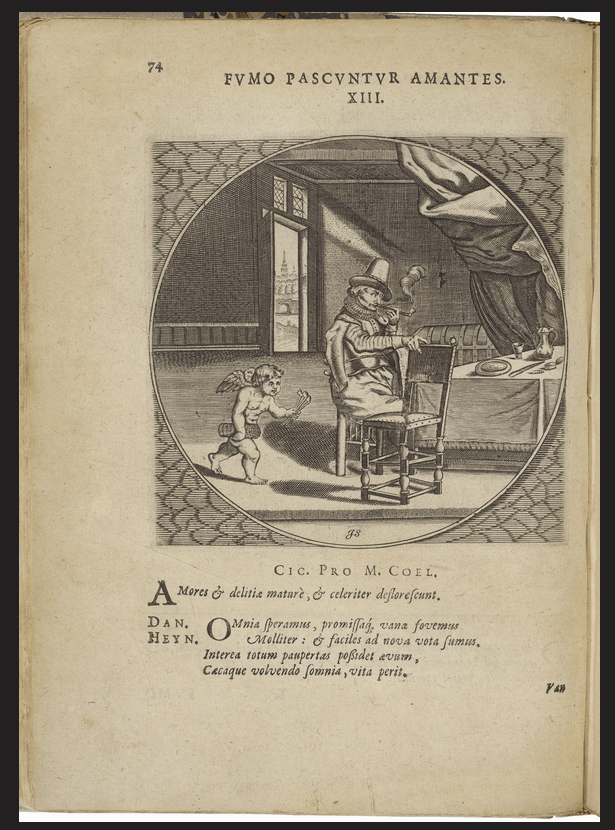
From “Proteus ofte Minne-beelden verandert in Sinne-beelden door,” by Jacob Cats (1577-1660). The chair should look familiar to any Peter Follansbee followers.

I follow the Folger Shakespeare Library on social media primarily for the Shakespeare, but today on Instagram, the library announced its new project: British Book Illustrations, with more than 10,000 images, which are searchable by keywords, from early books.

Screen Shot 2019-02-04 at 4.31.09 PM

Birthing chair from “The expert midwife, or An excellent and most necessary treatise of the generation and birth of man. Wherein is contained many very notable and necessary particulars requisite to be knovvne and practised: with diuers apt and usefull figures appropriated to this worke. Also the causes, signes, and various cures, of the most principall maladies and infirmities incident to women. Six bookes compiled in Latine by the industry of Iames Rueff, a learned and expert chirurgion: and now translated into English for the generall good and benefit of this nation,” by Jakob Rüff (1500-1558).

So I’ve been tooling around for an hour now with such terms as “chair,” “table” and “house” (sadly, “workbenches” and “woodworking” bring up nothing).

This is a simply tremendous visual resource!

Screen Shot 2019-02-04 at 4.44.57 PM

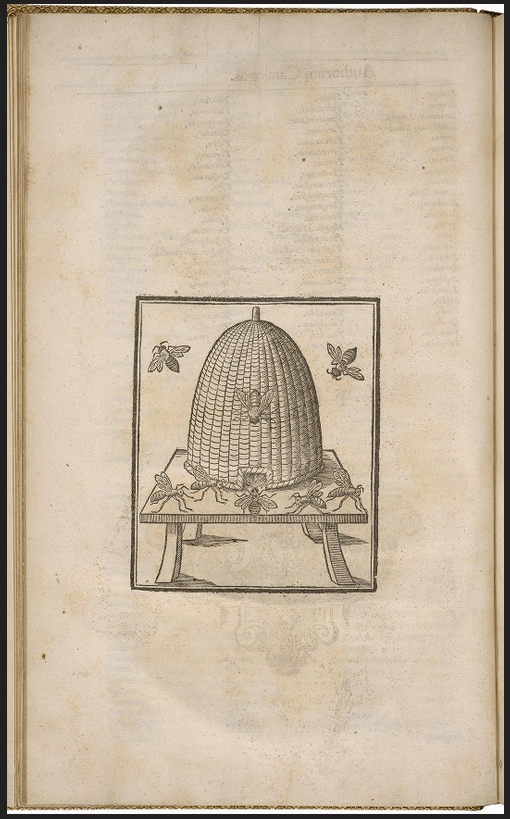
Skep (and table on which to put it) from “Insectorum sive minimorum animalium theatrum olim ab Edoardo Wottono, Conrado Gesnero, Thomaque Pennio inchoatum ; tandem Tho. Movfeti Londinâtis operâ sumptibusq´[ue] maximis concinnatum, auctum, perfectum ; et ad vivum expressis iconibus suprà quinge,” Thomas Moffet (1553-1604).

Posted in Uncategorized | 4 Comments

‘Operations of Carpentry’

Plate8

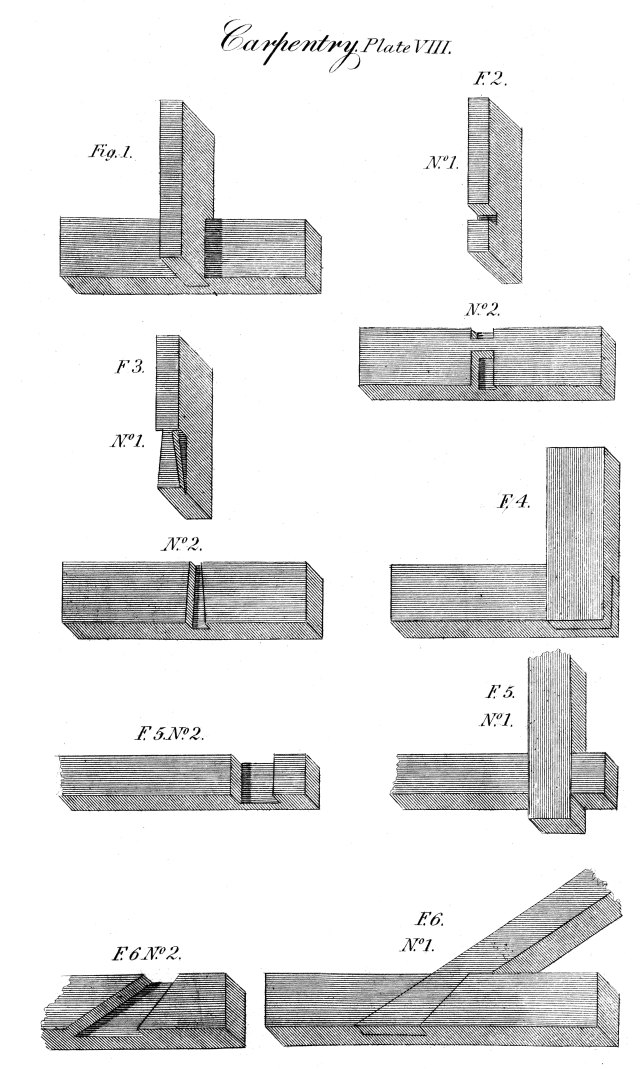
Having now mentioned the principal tools, and their application, it will here be proper to say something of the operations of Car­pentry, which may be considered under two general heads; one of individual pieces, the other the combination of two or more pieces. Individual pieces undergo various operations as sawing, planing, rebating, and grooving, or ploughing: the operation of the pit saw is so well known as hardly to need a description; planing, rebating, grooving, or ploughing, are more frequently employed in Joinery, and will be there fully described. The other general head may be sub-divided into two others, viz. that of joining one piece of timber to another, in order to make one, two, or four angles, the other that of fastening two or more pieces together, in order to form one piece, which could not be got sufficiently large or long in a single piece; there are two methods of joining pieces at an angle, one by notching, the other by mortise and tenon…

Fig. 1 the manner of cocking tie beams with the wall plates fitted together. See § 25.
Fig. 2 shows the manner by which the cocking joint is fitted together, No. 1 part of the end of the tie beam, with the notch to receive the part between the notches in No. 2, which is a part of the wall plate. See § 25.
Fig. 3 dove-tail cocking; No. 1 the male or exterior dove-tail cut out on the end of the tie beam: No. 2 the female or interior dove-tail cut out of the wall plate, to receive the male dove-tail. See § 24.
Fig. 4 the manner of joining two pieces together to form a right angle, so that each piece will only be extended on one side of the other, by halving the pieces together, or taking a notch out of each, half the thickness. See § 26.
Fig. 5 two pieces joined together, forming four right angles, when one piece only exceeds the breadth of the other by a very short distance: No. 2 the socket of one piece, which receives the neck or substance of the other. This and the preceding are both employed in joining wall plates at the angle; but the latter is pre­ferable, when the thickness of walls will admit of it.
Fig. 6 the method of fixing angle tics: No. 1 part of angle tie, with part of the wall plate: No. 2 the wall plate, showing the socket or female dove-tail. Though the angle tie is here shown flush with the wall, in order to show the manner of connecting the two pieces together; the angle tie is seldom, or never let down flush, as this would not only weaken the angle tie, but also the plate into which it is framed. See § 27.

MCOnlineCoverExcerpted from “The Mechanic’s Companion,” by Peter Nicholson.

Posted in Uncategorized | Leave a comment

ATC Interior Tweaks

openSeveral people have asked if the panel saws stored on my lid interior keep my old “Anarchist’s Tool Chest” from closing. The answer is both yes and no.

It closes fully if I slide the top tray to between 5″ and 6-1/2″ from the front edge. And while this sounds persnickety, I’ve become accustomed to it; my hands automatically reposition that tray when I’m done rooting around inside the thing, so it closes with no problem. But if I don’t (say, when I’m intentionally trying to make it not fully close for a picture), one of the saw handles catches the edge of the tray, and the dust seal doesn’t seal. And if you take  look at the bevel on the bottom skirt, you’ll see that I really need that dust seal to seal…

closed

So on the chest I’m working on now (which I’ll keep at the Lost Art Press shop), I’m going to tweak the interior a bit so as to not have to be precise in that tray location. There’s enough room on top of my moulding planes to lower the bottom till runner by about 3/4″ and still have plenty of room underneath to fit a half-set of modern hollows and rounds (should I ever acquire such a heady thing!). That will allow me to keep the tills the same size (the top two are 2-3/4″ tall, including the nailed-on bottoms) x 10 deep; the bottom one is 4-1/2″ tall x 10″ deep*) but lower them in the case just enough to overcome the saw-handle issue. Assuming I don’t overfill the top till, of course.

interior

* My till sizes are slightly different than what Christopher Schwarz shows in his book. His are all 9″ deep, and his bottom till is 5-1/2″ tall. I believe the depth of his tills is dictated by the saw till in the bottom front of his chest; because I’ve disobeyed him on saw storage (in addition to moving the panel saws to the lid, my backsaws hang behind my chisel rack on the front wall), I can get away with that extra inch.

Posted in Uncategorized | 4 Comments

James G. Apple, 1937-2019

jimThis obituary for my step-father, Jim Apple, was published in The Washington Post on Jan. 27, 2019. While I learned a lot about him during the 28 years he and my mother were married, he was so self-effacing and humble that I didn’t realize until reading this the breadth of his professional accomplishments. What I do know is that Jim was unfailingly kind and generous to me, and I will miss him.

APPLE James G. Apple Of Louisville, Kentucky age 81, passed away peacefully on January 22, 2019 with his children by his side after a courageous battle with heart disease.

He was born in Huntington, West Virginia on September 20, 1937 to Bernice Stewart and David French Apple Sr. Jim was a dedicated father and grandfather, an extraordinarily compassionate lawyer, author, speaker, adventurer, fervent reader and traveler. A true gentleman to the end, he was known for his keen intelligence and humor, love of education, research and knowledge, and a kind and caring nature.

He grew up in Fort Thomas, Kentucky, attending Highlands High School. He graduated from the University of Virginia with Honors, was a member of Phi Delta Theta Fraternity, the Raven Society, The Z Society, Omicron Delta Kappa, and the Editor-In-Chief of The Cavalier Daily. After college, he attended the University of Virginia School of Law, serving as managing editor of the Virginia Law Review and a member of the Order of the Coif.

Following graduation, Mr. Apple was a 1st Lieutenant, special intelligence, with the U.S. Army Reserves at both Fort Knox and Fort Meade. After military service he moved to Paducah, Kentucky to practice law. Moving to Frankfort in 1967, he was a member of Governor Louie B. Nunn’s “Kiddie Corps,” serving as administrative assistant for transportation affairs and in 1969 was named Executive Assistant to the Kentucky Highway Commission.

After his tenure with state government, he moved his family to Louisville where he had a successful law career with Stites & Harbison, arguing approximately 97 cases. After twenty years with the firm, he attended the University of Edinburgh, earning a Master of Laws (L.L.M.) degree in international and comparative law. He then joined the Federal Judicial Center in Washington, DC, the education, training, research and development arm of the federal court system in the U.S., as Special Assistant and Counsel to the Director.

After a decade with the FJC, he helped found and was president of the International Judicial Academy, until his semi-retirement in 2017. He counseled and mentored hundreds and hundreds and hundreds of lawyers and judges throughout his career.

Having served on the Transit Authority of River City (TARC) Board for nine years, chairman from 1981 to 1985, he established the Toonerville Trolley in Louisville. He was a 1984 graduate of Leadership Louisville, former member of the Pendennis Club, and member of the Cosmos Club and National Press Club (both in Washington, DC), and the Kentucky, Louisville, Virginia and American Bar Associations, having founded the Young Lawyers Section with the ABA. He was an elder at Second Presbyterian Church, Louisville, KY, and affiliated with the Old Presbyterian Meeting House, Alexandria, VA. He received many awards and accolades throughout his 50-year career.

He was an avid reader, enjoying his membership with the “Serious Book” Club, amateur photographer, traveler, traveling to 58 countries in his lifetime, and former tennis player and mini-marathoner. A prolific writer, he authored numerous award winning articles, founded an internationally recognized legal blog, the International Judicial Monitor, and co-authored three children’s books with his daughter, “Henry the Doggie Detective.” He enjoyed spending summers with his children and grandchildren in Kiawah Island, South Carolina.

Jim is survived by his brother, David French Apple, Jr., M.D. (Jane), of Atlanta, Georgia, his daughter, Meredith Lambe (Thomas) and son, Miles Apple (Sandy), his grandchildren, Philip, Marshall and Malcolm Gault, and Stewart, Eloise and Iris Apple, all of Louisville, three nieces, a nephew, extended family, his wife, Elizabeth Jones, of Alexandria, Virginia, and stepchildren, Megan Fitzpatrick and Ian Jones.

Visitation will be at Pearson’s, 149 Breckinridge Lane (Louisville, KY) on Monday, January 28 from 4 to 7 p.m. A Memorial service will be at 11 a.m., Tuesday, January 29 at Second Presbyterian Church, 3701 Old Brownsboro Road (Louisville). There will be a private graveside service for family at Cave Hill Cemetery, Louisville, KY. Memorial and dedication services will be held at the Old Presbyterian Meeting House in Alexandria, Virginia this spring.

He was preceded in death by his parents. In lieu of flowers, expressions of sympathy may be made to the Ft. Thomas Education Foundation, P.O. Box 75090, 28 N. Ft. Thomas Ave., Ft. Thomas, KY 41075; Louisville Bar Foundation, 600 W. Main St., Louisville, KY 40202; University of Virginia School of Law, 580 Massie Road, Charlottesville, VA 22903-1738, or charity of choice.

Posted in Uncategorized | 14 Comments

‘They say miracles are past…’

pb-409 copy

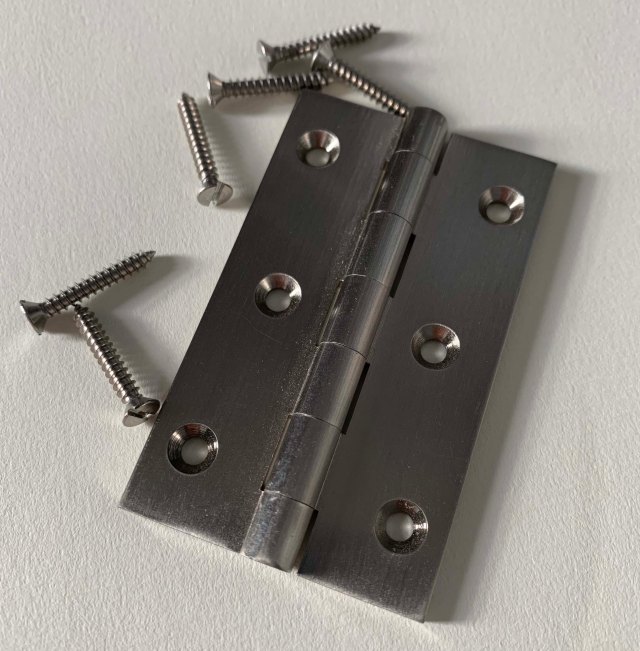
As I was ordering milk paint and hardware for my new “Anarchist’s Tool Chest” this morning, I scrabbled through my large and motley collection of random hardware…and lo, I unearthed not only the extra Horton Brasses PB-409 Precision Butt Hinge from my 2012 ATC build (they come in pairs, but one needs only three), but the matching screws!

A minor savings from a minor miracle.

screen shot 2019-01-27 at 10.10.51 am

I’ve decided on ‘Dragonfly’ from the Real Milk Paint Co.

Posted in Uncategorized | 14 Comments

50 Dovetails in 5 Days – What’s Next?

classCarcases: seven per corner; lower skirts: three per corner; upper skirts: two per corner; dust seal: one at each end. That’s 50, right? Multiply that times six students, plus me, and that’s…a total of 340 (I didn’t manage to get to my upper skirt and dust deal) dovetails cut in the last five days in my  “Anarchist’s Tool Chest” class at the Lost Art Press shop.
All the guys did a fantastic job, and left with six great-looking chests. I promised them a roundup of what comes next (beyond what’s in Christopher Schwarz’s book), so here it is, with links to resources. Figured I might as well post it as email it.

The glue wasn’t quite dry enough on the dust seals (and the road was calling), so I sent everyone home with a handful of 6d Tremont fine finish nails, and instructions to drill pilot holes (3/32″) and put five nails across the front and three on each side, then use a nail set to sink them slightly below the surface. Belt and suspenders. (To attach the bottom boards, we used Rivierre diamond-head nails, available in the U.S. from Lie-Nielsen Toolworks and Lee Valley Tools.)

With that done, it’s on to making it functional for more than blanket storage.

Innards
How Christopher Schwarz does it now (a bit different than what’s in his book):
https://blog.lostartpress.com/2018/03/31/tool-chest-updates-the-innards/

https://blog.lostartpress.com/2018/04/23/tool-chest-changes-to-the-sawtill/

What mine at home looks like, with panel saws in the lid…

panelsaws

…and backsaws hanging behind the 7/8″-thick x 1-1/8-wide tool rack (the saw slot spacers are 5/8″ thick and 2″ wide; the front wall of the slot rack is 3/8″ thick x 2″ wide):

strip

The tool rack and slot rack, empty

img_1509

The tool rack and slot rack (and tills) with saws and tools therein.

You might notice in the photo above that not only do my drawer-bottom species not match (I used what I had), but that the drawer sides (the middle one, in particular) are slightly shy of the chest walls – only the nailed-on drawer bottoms extend to the runners. They’re easier to fit that way.

Lifts & Hardware
Wooden lifts:
https://blog.lostartpress.com/2018/04/26/tool-chest-dog-bone-lifts/

Beckets:
Rope handles – I’ve not used them on anything, but sure they look nifty:
http://www.marlinespike.com/beckets.html


Iron lifts:
Check out eBay and other auction sites for beefy vintage ones, or go custom with your friendly blacksmith (those on my home chest were designed by Janet Switzer, and made by John Switzer at Black Bear Forge).

catlifts

For my new chest (which will live at the Lost Art Press shop), I’m hoping to commission iron lifts that are sleeping, curled-up cats, with the tail serving as the handle part – or better yet, an appropriately tweaked version of my Rude Mechanicals Press logo, with the tail as the handle.

Hinges, lock and drawer pulls:
Horton Brasses offers the hardware kit as seen in “The Anarchist’s Tool Chest”; it includes hinges, drawer pulls and a lock. But for my home chest, I ordered the hinges and pulls separate from the kit so I could get a nickel finish. Because…OOOOOO shiny. (And as you can see above, I’ve yet to install a lock – but the blue tape marking the area for it is holding strong!

You might also consider a crab lock – one from Peter Ross, perhaps. Or the manufactured version offered by Whitechapel if you’re a bit budgetarily constrained. (Peter also makes gorgeous chest hinges – as might your local blacksmith.)

Paint
If you have any divots or minor gaps you’d like to hide before you paint, fill them, let the product dry, then sand to level the surface. I prefer Durham’s Rock Hard Water Putty for this, but Bondo is another classic choice.

No matter what paint you use, you’ll almost certainly have to lightly sand after the first coat raises the grain – or raise the grain beforehand by misting with water, then sanding.

I like traditional milk paint – even though the first coat might make you cry. After several coats, it looks great (allowing the wood grain to show through) and wears well. I think on the new chest, I’ll use “Dragonfly” from the Real Milk Paint Company. Mike Dunbar’s article on milk paint is useful, as is this post from Peter Galbert. General Finishes makes a faux milk paint that’s easier to use and looks pretty good, though it obscures the grain. And there’s always latex. The inside gets either no finish, or a coat of shellac (if you must).

Posted in Uncategorized | 4 Comments

Review of ‘Mechanic’s Companion’

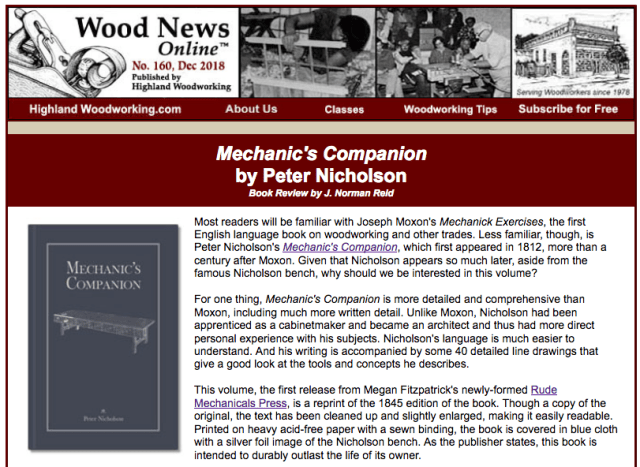
screen shot 2019-01-08 at 3.01.58 pmJ. Norman Reid (whom you might know as one of the names behind Shenandoah Tool Works)  wrote this nice review of “Mechanic’s Companion” for the December issue of Highland Hardware’s Wood News Online. Thanks Mr. Reid!

And speaking of Highland Hardware, I believe there are still some spots available in my March 2-3 hand-cut dovetails class (a.k.a. Shaker tray class) at the Atlanta woodworking store.

Hope to see you there!


Posted in Uncategorized | 2 Comments

Dovetail Fixes (If You Must)

through

Yes, you can see a shim here if you look really closely…but no one other than you will likely notice (unless, of course, you point it out…as all woodworkers seem compelled to do.)

I’m scheduled to teach myriad classes next year both at Lost Art Press and around the country ( at Port Townsend School of Woodworking, Highland Woodworking, Lie-Nielsen Toolworks – that one will be posted soon). Almost all of them involve dovetails. Plus, I’ve received a couple of questions in the last week or two concerning how to fix “bad” dovetails. And Christopher Schwarz is now in the glue-up stage of a multi-case dovetailed project, and I’ve parts for four dovetailed drawers on my bench at this very moment (which I plan to cut later today and tomorrow…to clear off my bench before this weekend’s class!)


Which is to say I (just about always) have dovetails on the brain.

So, below is my bullet-point list of talking points for dovetails fixes

Baseline Error Fixes
1. Try to clamp it out. Blocks on the tails, squirt a runny glue in there (white glue, Old Brown Glue, West System epoxy) then clamp the snot out of it.
2. Bishoping (if tails/pins are proud). Wet the tail/pin, then tap gently with ball-peen hammer to mushroom it a little. Don’t peen below carcase surface.
3. Controlled spelching (that is, try to break out the fibers when planing…in the correct direction).
4. White glue & sandpaper.
5. For big gaps, shims (in same species and grain direction). Glue them in, them flush when the glue dries.)
6. Durham’s Water Putty, then paint.
7. Live with it; the build will (likely) stay together.

Splay Error Fixes
1. Kerf through middle of tail/pin then wedge.
2. Kerf through joint for even gap, then wedge.
3. Durham’s Water Putty, then paint.
4. Live with it; the build will (likely) stay together.

(Other) Errant Sawing Fixes
1. Cross the baseline? Glue in a flat or round toothpick. Flush. Color w/Sharpie.
2. Bite into a pin or tail while coping? See above.
3. Live with it; the build will (likely) stay together.

Assembly ‘Error’ Fix
1. Crushed tail corner? Glue in a flat or round toothpick. Flush. Color w/Sharpie.
3. Live with it; the build will stay (likely) together.

“Cabinetmakers have been hiding dovetail mistakes from rich people for centuries.”
— the guy who taught Schwarz to cut dovetails

“Everyone who has ever cut a dovetail has &*%^ed up a dovetail.”
— Me and everyone else who’s ever talked about the joint

Posted in Uncategorized | 3 Comments