Learn Dovetails; Build a Stool

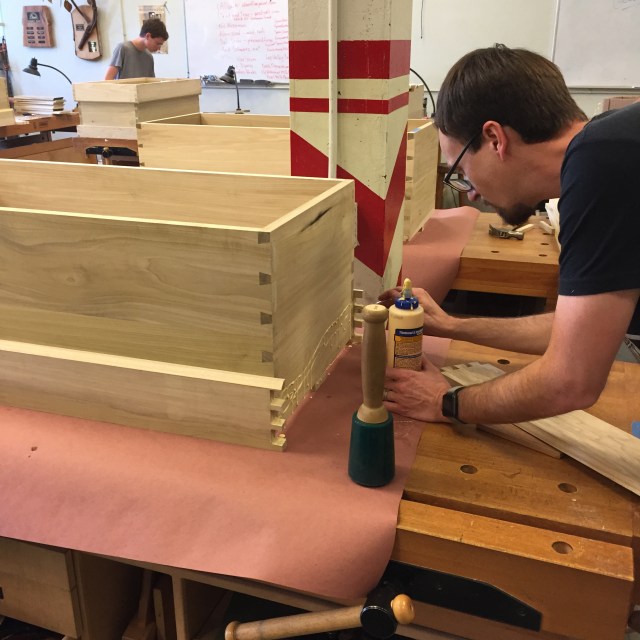
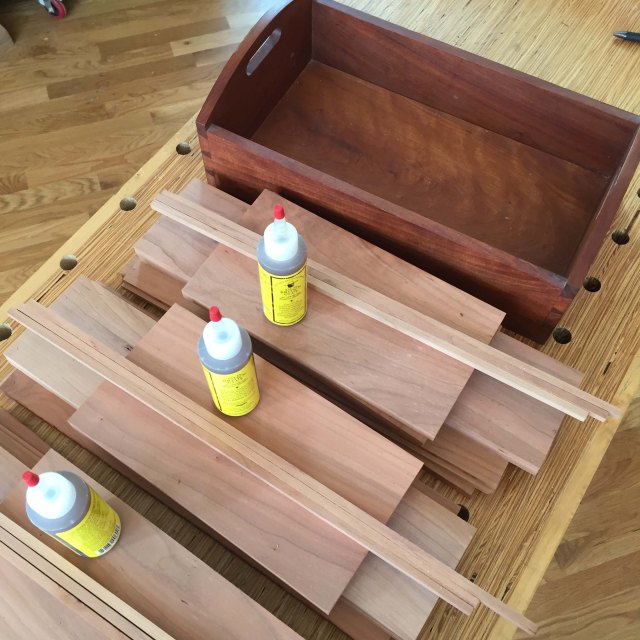
StepStoolWant to learn some tricks for cutting great dovetails, and build a classic step stool in cherry as you do it? A student had to drop from the “Build a Shaker Step Stool” class at the Lost Art Press storefront/shop July 28-29, so there’s one opening.

The cost is $340, including materials, and lunch is included on both days (I’m thinking Eli’s BBQ for at least one of them – yum!)

Posted in Uncategorized | Leave a comment

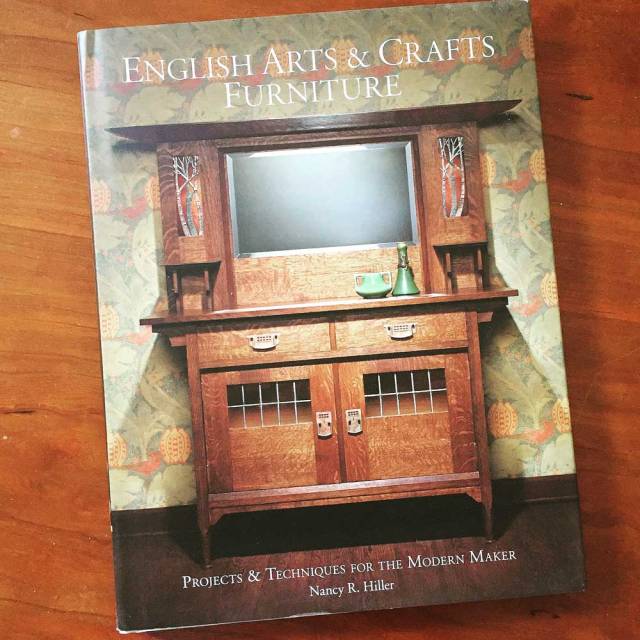
‘English Arts & Crafts Furniture’

cover

I’m proud of most of the work I did at Popular Woodworking, but championing Nancy Hiller’s gorgeous new book, “English Arts & Crafts Furniture,” is near the top of my list of PW accomplishments. Heck – I was so invested in helping to make it a success that I continued working on it after I’d left the company.

Nancy commences with a look at the history of the movement, and ponders if we should even consider it a style. As she points out, the design differences among the  works of Gustav Stickley, Charles Rennie Mackintosh, Mackay Hugh Baillie Scott and Ernest Gimson (among others) are legion, with more dissimilarities than commonalities, yet the ethos of John Ruskin is evident in much of it.

Style

She also includes plans and instruction for three somewhat lesser-known English Arts & Crafts furniture pieces – C.F.A. Voysey’s “Two Heart Chair,” a Harris Lebus sideboard and my favorite, Ernest Gimson’s hayrake table. You’ll find drawings and step-by-step plans for each.

“English Arts & Crafts Furniture” is available now at shopwoodworking.com, Amazon and other booksellers, or you can get it from Nancy in person – click here for a list of upcoming signing/release events.

hayrake

CHAPTER 1: Is Arts & Crafts a Style?
Ruskin’s Moral Elements of Gothic
William Morris
The Projects in this Book

CHAPTER 2: Voysey Two Heart Chair
An Intimate Assignation with a Chair
C.F.A. Voysey: Raising the Standard of British Design
Keeping Voysey’s Legacy Alive (on David Berman)
The Chair
Building the Chair
Cathryn Peters, the Wicker Woman

CHAPTER 3: Harris Lebus: Furniture for Everyman
Harris Lebus
Defining Details (on Ann Ryan Miller)
Harris Lebus Sideboard

CHAPTER 4: Gimson & the Barnsleys: Craft for the Maker
Going Up the Country
Hayrake Table
Decorative Gouging
Butterfly Keys

Afterword
Image Credits/Permissions
Bibliography
Index
Acknowledgements

Posted in Uncategorized | 3 Comments

Fastest Dovetailers in the West

IMG_8243

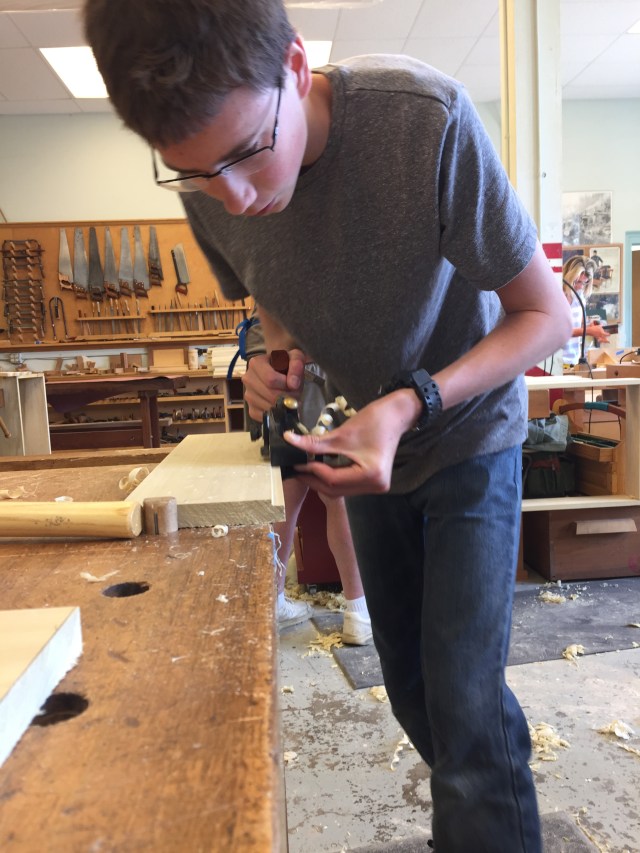
Maybe it’s the delightful cool air off the Puget Sound that lends everyone some extra oomph? I’m teaching at the stunningly beautiful Port Townsend School of Woodworking this week, and things are going well – almost too well.

Or maybe it’s that every student has a full kit of sharp and well set-up tools, and plenty of room to work? We’re far ahead of schedule.

We’re building a small English tool chest – the traveling version of  Christopher Schwarz’s “Anarchist’s Tool Chest.” I figured that with only five days, it would be difficult to get a full-sized one completed. I was wrong.

Yesterday afternoon, we got the skirts glued on to all but two chests…and had we had a few more clamps, I think all of them would be a day ahead of my plan. What I thought would be two days of dovetailing flat-out turned into one, so we’re now on Plan B…or C.

I was going to shiplap everyone’s bottom boards on the table saw or shaper; instead, they’re rabbeting by hand.

IMG_8221

This morning, we’ll nail the bottoms in place and move on to the dust seal (the small skirt at the top)…on which I’m now encouraging they try fancier dovetails with tiny pins that have but a saw kerf between…just to slow things down (and learn a new technique).

Then, we’ll be doing all the joinery for the lid by hand, too (instead of my prepping the joints on the machines).

By Friday, I might be running out for paint.

IMG_8218

I can’t recommend the school highly enough. It is in one of the most lovely places I’ve ever seen, and it seems the sea air works miracles.

IMG_8240

The main school building, in a former mechanicals room (I think) at Fort Worden.

Posted in Uncategorized | 2 Comments

Wanted: Mary Poppins’ Magic Carpet Bag

chest

I work out of this chest at home (and a slightly smaller one at the Lost Art Press shop, which is but seven miles from my house, so I can easily zip home if necessary)…

Next week is my Traveling Tool Chest class at the Port Townsend School of Woodworking, and given that it’s a 37-hour drive and a boat ride or two away from Cincinnati, I’m getting on a plane instead and checking my tools. As a result, I’ve had to winnow my kit down to (below) the bare minimum – which always makes me terribly anxious. Typically, I just throw everything I could possibly need (and lots I couldn’t possibly need) into the back of my car and take off. (My running joke when there’s something we need in the Lost Art Press shop: “Wait – I might have that in my car!” And I often do.) I can’t do that here – and my borrowed Pelican Case is a small one.

While the school does, of course, have a goodly set of tools and machines, I like working with my own familiar hand tools whenever possible.

To help organize my mind and my classes, I always make a list – then revise it at least five times – by writing bullet-point lessons plans for every day, and noting the necessary tools for each operation. Said plans not only help me pack in the instances when I can’t haul the kitchen sink, but keep me on track/help me not make a complete ass of myself while teaching.  Note that the list doesn’t include all the tools one might wish to build a chest; it includes only the tools for which I’ve a perhaps unhealthy attachment.

Still I’m sure that despite my best efforts I will have left out something over which I will wail…but whatever it turns out to be, it wouldn’t have fit anyway. And as I write this, I’m only on revision number three; there will no doubt be additions/deletions/substitutions as I try to squeeze everything in. But the ones in bold? They’re my absolute musts. I’ll borrow a hammer, sharpening stones and the like…but I do so love my planes and dovetail saw. (Clothes and toiletries I’ll worry about late Friday night – those are easier!)

No. 3
No. 5
Dividers (2)
Dovetail Marker
Mechanical Pencil
Cutting Gauge
Marking Knife
Dovetail saw
Coping saw & blades
1/2″ & 3/8″ chisels
Mallet
Machinist’s square
Pinch sticks (maybe)
Straight rabbet OR shoulder plane
Mortise chisel
Tenon saw
Beading plane
Small bevel square
Apron plane
Flush-cut saw
Honing guide (maybe)
Plow plane
No. 48 (maybe)
6″ square
12′ tape measure
Cut nails
(Because I’m pretty sure I forgot to ask PTSW to order some…)

And yes, I realize all the “maybes” are lightweight items that take up little space, thankyouverymuch.

pelican

This “chest” is slightly smaller than the one at top. (Medium-sized cat for scale – he doesn’t get to go.) Can one have a mallet in carry-on luggage? Asking for a friend.


Posted in Uncategorized | 11 Comments

Donor-Made – EAIA 2018

BobVogelShakerBoxes

Bob Vogel – Shaker oval boxes.

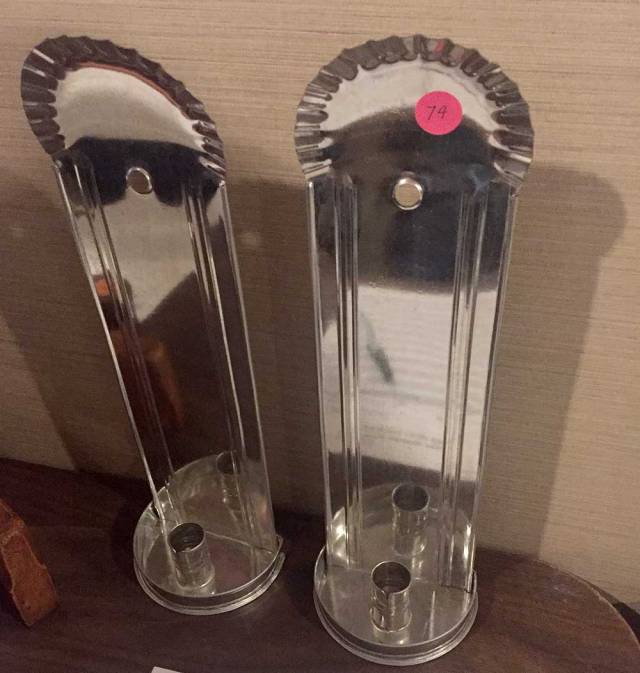
At the 2018 Early American Industries Association annual meeting (held this year in Bethlehem, Pennsylvania), one of the things I most enjoyed (beyond meeting everyone, of course!) was the silent auction, to which members donate items to raise money for the organization. There was lots of good stuff therein, but I was particularly drawn to those offerings made by EAIA members (one of which was member Milton Bacheller’s book on American marking gauges that I bought for the Mechanical Library at Lost Art Press). Above and below are shown just a few of those items (with my apologies for the poor pictures…light was limited and I had only my not-so-new phone as a camera).

Members come from all backgrounds, and while not all are “makers,” what we have in common is an appreciation for the tools of the trades of any early American industry, be it woodworking, fiber arts, blacksmithing, tinsmithing, ice house implements, leatherwork, distilling, mining, boatbuilding, agriculture, mills of all sorts…the list is darn-near endless. (That’s a not-so-subtle hint that if you’ve an interest in early tools for just about any trade to please consider joining, and/or consider talking with me about about sharing your knowledge in a future* Chronicle article!)

William-McMullen-Sconces

William McMullen – Tin sconces.

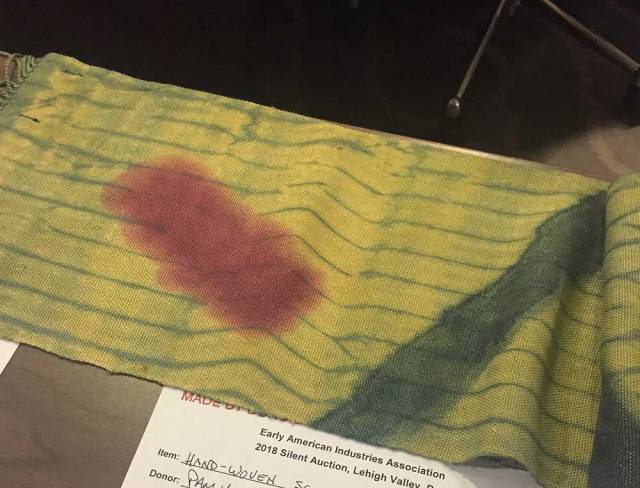
PamHowardScarf

Pam Howard – Hand-woven scarf.

DonGrffininGoblets

Don Griffin – Turned Goblets.

RonHowardHoldfast

Ron Howard – Holdfast.

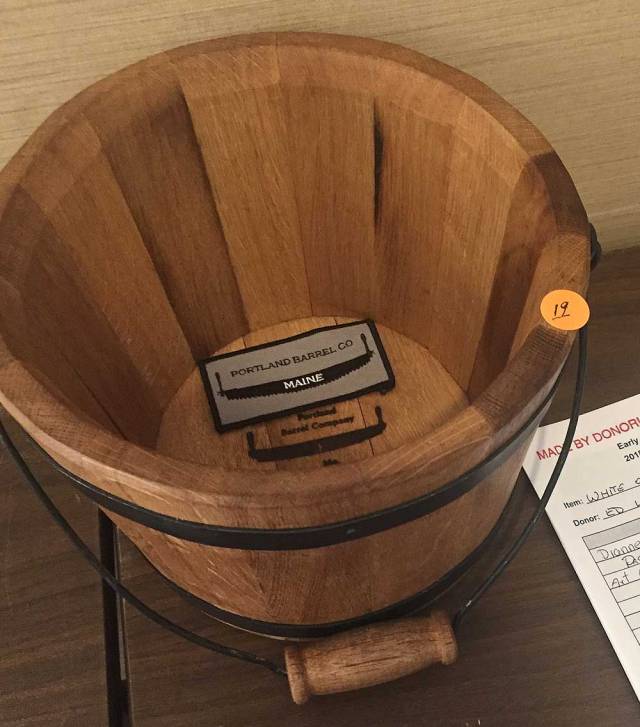
EdLutjens-Pail

Ed Lutjens – White oak pail.

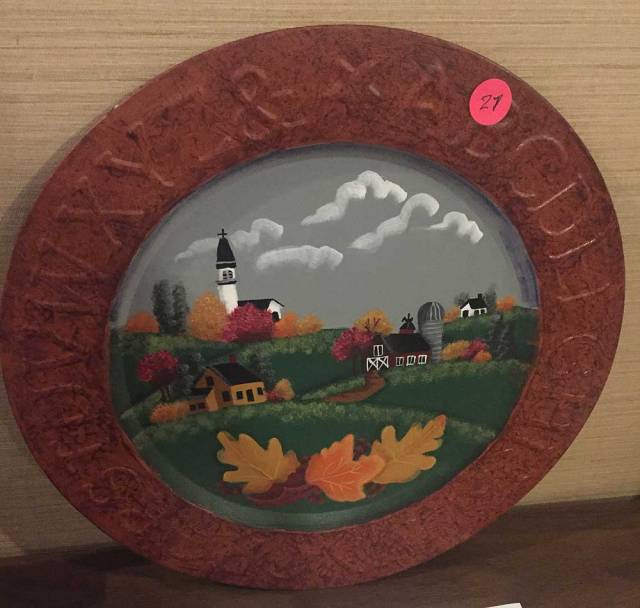
DaleGriffinsPlate

Dale Griffins – tole-painted plate.

* I take the reins as editor with the Autumn 2018 issue – a daunting task. Patty MacLeish’s shoes will be hard to fill; she’s done a sterling job with the publication for almost two decades!

Posted in Uncategorized | 1 Comment

Rude Mechanicals Press Privacy Policy

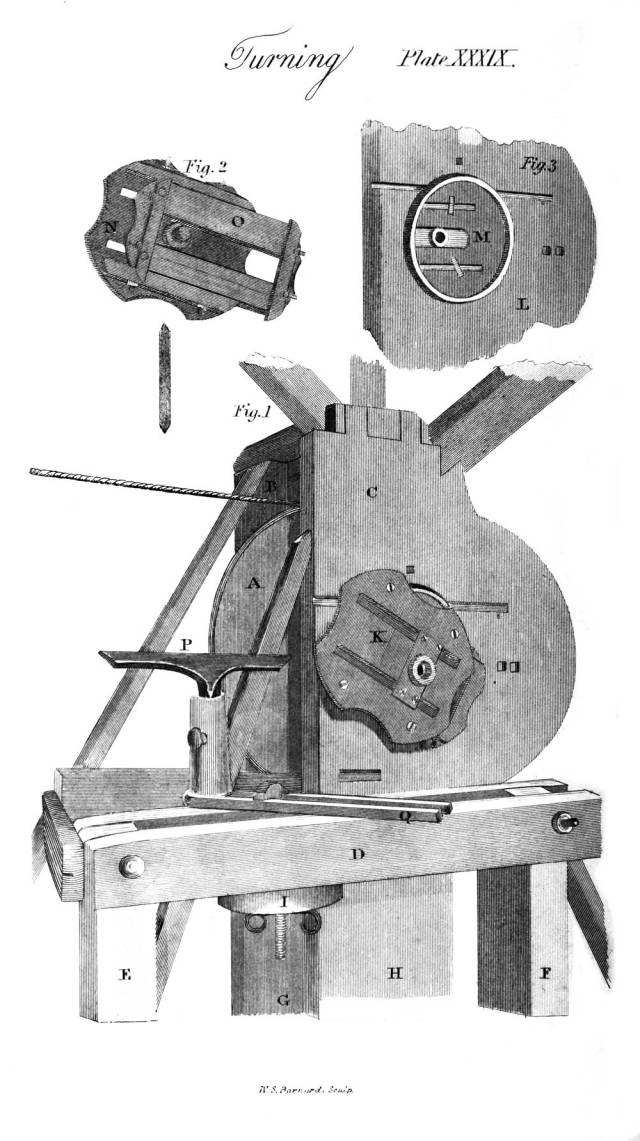
Plate39_Turning

Plate 39, from Peter Nicholson’s “The Mechanic’s Companion” (which is simply a nice image that has nothing to do with the privacy policy…because nothing from an early 19th-century book does). See below for Nicholson’s description.

I’ve been inundated with privacy policy updates from the various sites on which I’ve accounts (I’m sure you have been, too!), and by Shopify to ensure that the Rude Mechanicals Press (RMP) store privacy policy is in compliance with the General Data Protection Regulation. It is.

The privacy policy started out simple, and remains the same: I will not sell or share your personal information with anyone. I do not engage in marketing involving e-mail, the telephone or mail to your physical business or residence. I do not retain your credit card numbers. I do not require you to register to shop with RMP (though you can if you like – and you have access to change or delete any information therein).

If you have any privacy or security questions, please contact me at meganfitzpatrick@fuse.net.

Plate 39 Description:

Fig. 1 is a view of the end of the machine; the principal parts shown in this view are
A the pulley of the mandrel.
B and C sides of the frame supporting the pulley.
D frame for the rest to slide in.
E and F legs supporting the frame D.
G and H continuation of B and C below the frame of the rest.
I nut and screw under the frame of the rest.
K the elliptic chuck with two grooves, through which the knobs of the slider pass, and are connected on the outside by a strong bar of iron, which is screwed upon their ends. This also shows the screw for fastening the board to which the work is fixed. This frame is strongly braced to the roof, in order to keep it steady.
P the rest.
Q the piece by which the rest is fastened.
Fig. 2 a view of the inside of the chuck, containing the parts N and O: this side of the chuck being placed against the side C of the frame, Fig. 1.
N the board containing the slider O, showing the end of the screw which is fixed in the mandrel; the board N revolves round a centre, while the slider O not only moves round, but has a longitudinal motion to and fro in the part N.
Fig. 3 a view of the outside of the mandrel frame, showing the parts L and M.
L a part of the side C of the mandrel frame, showing the ring M which is fastened to 1t and which causes the reciprocal motion of the slider O in Fig 2.

Posted in Uncategorized | Leave a comment

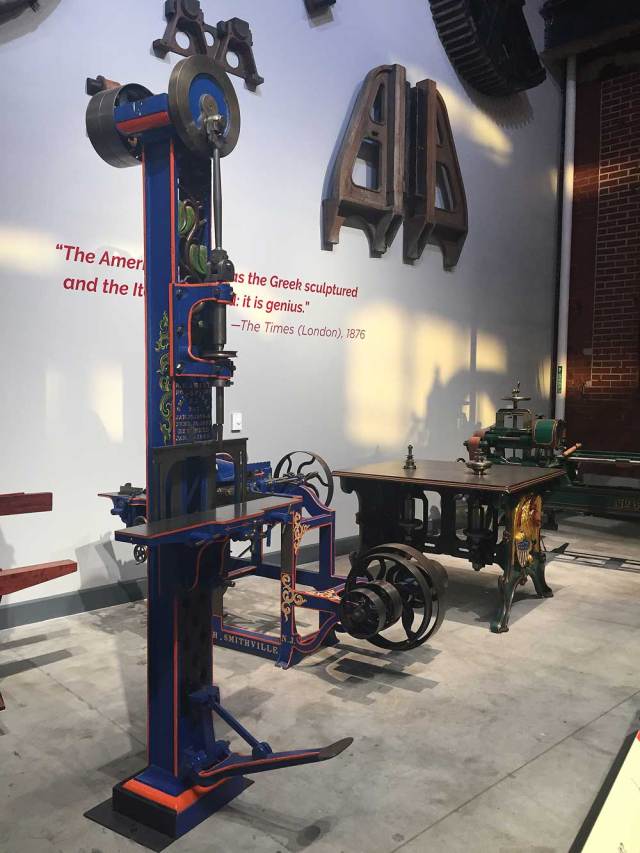
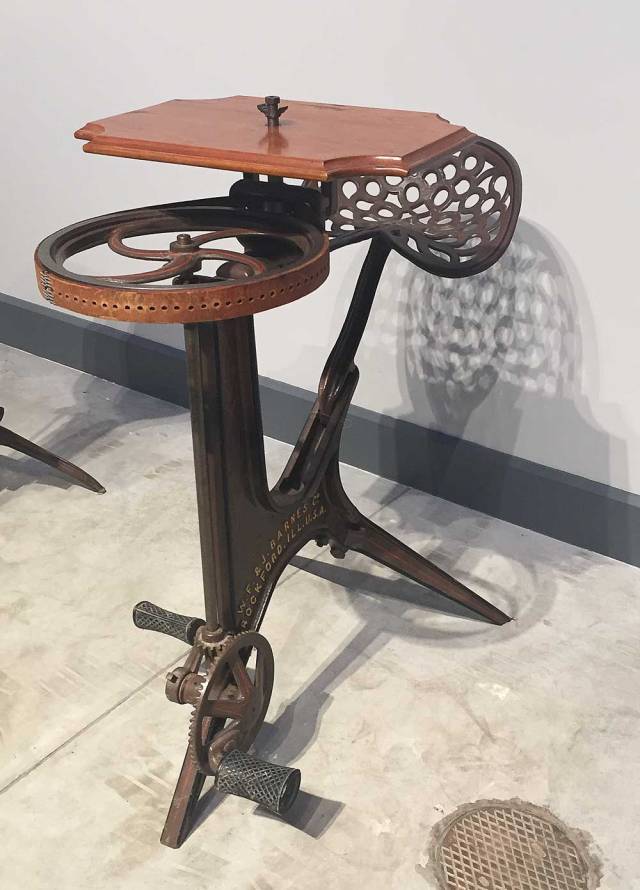
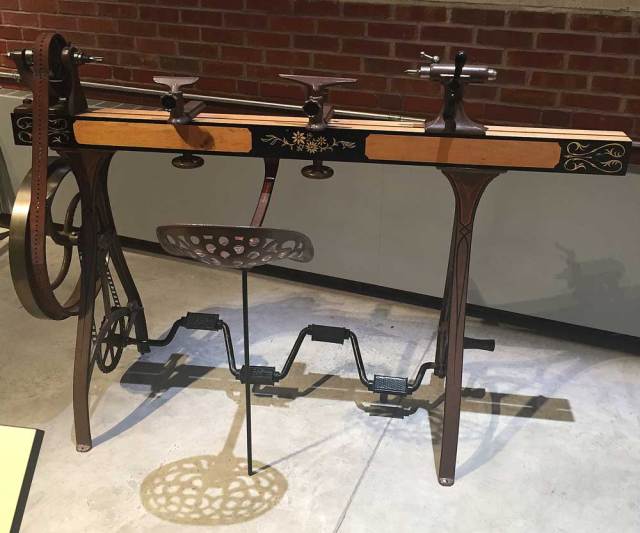
Early Woodworking Machinery

FootMortiser

H.B. Smith Mortising Machine

The 2018 Early American Industries Association Annual Meeting is in Bethlehem, Pennsylvania, this year, and after a blue-sky day of visiting the Moravian Museum and sites, the Kemerer Museum and Bethlehem Steel, this evening we met up at the National Museum of Industrial History for ice cream and a private tour. (The museum is in a beautifully restored building on the Bethlehem Steel site.)

It is no surprise that I was most enchanted with the museum’s incredible collection of early woodworking machinery (though the printing collection runs a close second).

Below are just a few photos of this gorgeous equipment. If you like “old arn,” this museum is a must see.

CBRogersDualShaper

C.B. Rogers No. 1 Dual Shaper

CB Rogers No. 6 TenonMachine

C.B. Rogers No. 6 Tenon Machine

Barnes-Router-Table

Barnes Router Table

BarnesLathe

Barnes Lathe

BarnesScrollsaw

Barnes Scrollsaw

BarnesRipSaw

Barnes Ripsaw


Posted in Uncategorized | 10 Comments

The Square, Plate 13, Figure 11

SquareFig. 11 the square, a b c the outer square, d e f the inner square, a d e the stock or handle, b c f e the blade.

§56. The Square, Plate 13, Figure 11.
Consists of two rectangular prismatic pieces of wood, or one of wood, and the other which is the thinest [sic], of steel, fixed together, each at one of their extremities, so as to form a right angle both internally and externally; the interior right angle is therefore called the inner square, and the exterior one the outer square. The side of the square which contains the mortise, or through which the end of the other piece passes, is made very thick, not only that it may be strong enough for containing the tenon of the other piece, but that it should keep steady and flat when used; and the piece which contains the tenon is made thin, in order to observe more clearly whether the edge of the square and the wood coincide. The thick side of the square is called the stock or handle, and the narrow surface of the handle is always applied to the vertical surface of the wood. The thin side of the square is called the blade, and the inner edge of the blade is always applied to the horizontal surface of the wood. Squares are of different dimensions according to their use: some are employed in trying-up wood, and some for setting out work; the former is called a trying square, and the latter a setting-out square; the blade ought to be of steel, and always ought to project beyond the end of the stock, particularly if made of wood. The stock is always made thick, that it may be used as a kind of fence in keep­ing the blade at right angles to the arris.

§57. To prove a Square.
Take a straight edged board which has been faced up, and apply the inner edge of the stock of the square to the straight edge of the board, laying the side of the tongue upon the face of the board; with a sharp point draw a line upon the surface of the board by the edge of the square: turn the square so that the other side of the blade may lie upon the face of the board; bring the stock close to the straight edge of the board, then if the edge of the square does not lie over the line, or any part of the line, the square must be shifted until it does, then if the edge of the tongue of the square and the line coincide, the square is already true: but if there is an open space between the farther side of the board and the straight edge, that is, if the farther end of the edge of the tongue of the square meets the farther end of the line from the straight edge, draw another line by the edge of the tongue of the square, and these two lines will form an acute angle with each other, the vertex of which will be at the farther side of the board, and the opening towards the straight edge: take the middle of the distance between the two lines at the arris, and draw a line from the middle point to the point of concourse of the lines: then the blade of the square must be shot or made straight, so as to coincide with this last line. The same, or a similar operation, must be repeated, if the contrary way.

From Peter Nicholson’s “The Mechanic’s Companion.”

Posted in Uncategorized | 1 Comment

‘Mechanic’s Companion’ Now Available for Pre-publication Orders

MCOnlineCover


I’ve now sent to the printer Peter Nicholson’s “Mechanic’s Companion”; it is scheduled to ship to my driveway in late June, then a few days later out to buyers (just as soon as I train the cats to wrap books…then give up and do it myself).

So, the online store for Rude Mechanicals Press (RMP) is now live (please excuse any initial hiccups). My modest goal is to release only a book or two per year for now, all of which will be of high quality and printed in the United States.

“Mechanic’s Companion” is among the classic tomes (and among the most readable) on woodworking and other building trades in the early 19th century (the first edition was published in 1812). Yet, with the exception of the well-known workbench from Plate 12, it doesn’t get as much attention as other early English technical books. That’s a shame, because it’s an invaluable and thorough treatment of techniques, with 40 plates that provide an excellent and detailed look at the tools of the time, along with a straightforward chapter on the geometry instruction necessary to the building trades.

Nicholson – unlike other technical writers of the time – was a trained cabinetmaker, who later became an architect, prolific author and teacher. So he writes (and writes well) with the authority of experience and clarity on all things carpentry and joinery. For the other trades covered – bricklaying, masonry, slating, plastering, painting, smithing and turning – he relies on masters for solid information and relays it in easy-to-understand prose. (The sections on wood-related trades are by far the most robust.)

There are, of course, online and print-on-demand versions of this book available, but I wanted a well-made, affordable copy that would last, and that one can take into the shop (but that still looks good on the shelf). This one is a scan of an 1845 edition that has been cleaned up in Photoshop, then printed a bit larger than the original for legibility.

This book is 6″x9″,  416 pages and printed on a natural acid-free paper, with just a hint of texture to evoke the look and feel of the original. The interior signatures are Smyth sewn (so the pages are durable but can be opened to relatively flat) and the hard cover is wrapped in cotton cloth and stamped in silver foil. The book is produced and printed entirely in the United States. It is built to last.

The price for Nicholson’s “Mechanic’s Companion” is $34, which includes domestic shipping.

P.S. For now, I cannot ship outside the U.S., but select retailers, including one in the U.K., have expressed interest in stocking this book. Please stay tuned! And know that RMP books will only ever be available direct from me and from reputable partners.
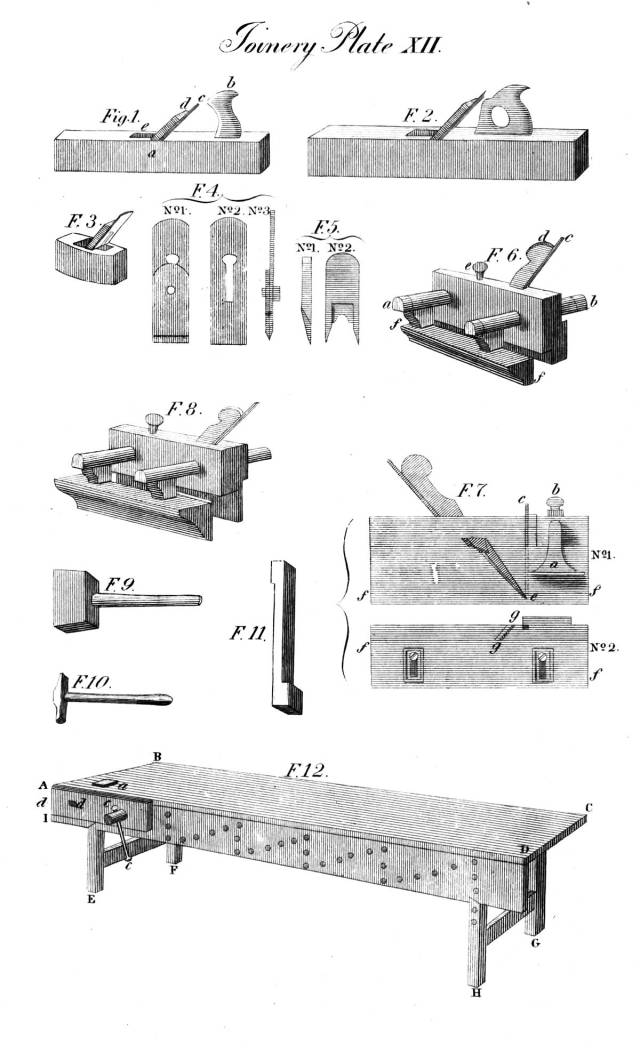
Plate12.Web

Posted in Uncategorized | 15 Comments

New Woodworking Classes at LAP

class

Registration will be live at Eventbrite Wednesday morning (5/9/18) at 9 a.m. EDT for the classes I announced here a couple of weeks back, as well as for two sector sessions from Brendan Gaffney and a chip carving class from Daniel Clay.

If you’re one of the first six to register, I (or Brendan or Daniel in the case of their classes) will be in touch regarding payment and tool lists. If you’re number seven or after, sign up for the waitlist –  I filled an empty slot in my last class from said list, so it’s worth it!

You can read more about the classes at the links below, or on the Lost Art Press Blog.

Note: All proceeds go directly to the instructor (in my case to various bills, the cat food store…and in a good month, the human food store). They are not a money-making enterprise for Christopher Schwarz or Lost Art Press; he’s just incredibly generous in letting me and others teach there (and in all things, really).

Chip Carving Class with Daniel Clay
July 7 & 8
Cost: $300, materials included (Click here to register: Will go live on 5/9/18 at 9 a.m.)

Dovetailed Shaker Step Stool with Megan Fitzpatrick
July 28 & 29
Cost: $340, which includes all materials. (Click here to register: Will go live on 5/9/18 at 9 a.m.)

Build the Cabinetmaker’s Sector with Brendan Gaffney
August 18-19, 2018 ($300, includes all materials)
(Click here to register: Will go live on 5/9/18 at 9 a.m.)

Boarded Bookshelf with Megan Fitzpatrick
August 25 & 26, 2018
Cost: $340, which includes all wood and Rivierre nails. (Click here to register: Will go live on 5/9/18 at 9 a.m.)

Build the Cabinetmaker’s Sector with Brendan Gaffney
September 15-16, 2018
(Click here to register: Will go live on 5/9/18 at 9 a.m.)

Dutch Tool Chest with Megan Fitzpatrick Sept. 22 & 23
September 22 & 23, 2018
Cost: $340, which includes the wood and nails/screws. (Click here to register: Will go live on 5/9/18 at 9 a.m.)

Make a Coffin-Shaped Bookcase…for use Now & Later with Megan Fitzpatrick
October 20 & 21, 2018 (just in time for Halloween!)
Cost: $340, which includes all materials. (Click here to register: Will go live on 5/9/18 at 9 a.m.)


Posted in Uncategorized | 1 Comment