True Confessions: I’m Grinding Averse

pregrind

These secondary bevels are embarrassingly wide.

I always avoid grinding far longer than I should (unless I hit a nail or something else catastrophic to a cutting edge). But with a year’s worth of loaning tools out to students and hundreds of dovetails of my own this year, it was a job on which I’ve procrastinated for far too long, on all my chisels and bench planes.

My secondary bevels (35°) were on most of my tools wider than my primary bevels (25°). As a result, my edges have breaking down quickly, and I’ve had to sharpen and hone a lot more often than I should. This has for weeks (months, really) not only been a waste of time, but also means I (and students) have been sharpening and honing a lot more steel than necessary, and as a result, probably not doing a very good job of it.

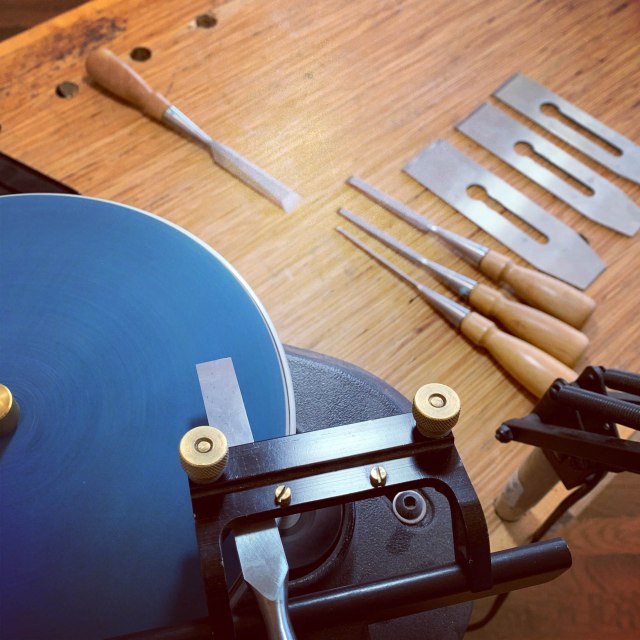
So today I sucked it up and pulled out Christopher Schwarz’s Veritas Mark II Sharpening System to regrind the primary bevel. Are grinding wheels faster? Yep. But (to my shame) I’m a bit scared of grinding wheels. I prefer the reliable consistency that a disc grinder and guide provides to the need for user skill and paying attention when using a wheel. (Note: I’ve also used and like the Work Sharp, and if I had carving and lathe tools to grind often(ish), might prefer it to the Veritas machine…but I rarely carve or use traditional lathe tools, so…).

grinding

I’d say the Veritas system is foolproof, but there’s always a bigger fool. But it is easy. Clamp the blade in the blade holder, using the setting jig to get the right projection for your desired angle, then rest the blade holder on the properly set tool rest, and lightly touch the blade to the right side of the wheel, moving it across the sandpaper to spread the wear. Stop every few seconds to make sure the blade isn’t too hot to touch (and if it is, dunk it in water), and keep grinding until your secondary bevel isn’t as wide as the Ohio River in spring (as mine were) – or until any nicks are gone, if that was the issue (as it was on two of mine, that I suspect had been dropped). Chris has a good video on it here.

I reground five Lie-Nielsen chisels and three blue-steel Japanese chisels (cue the slings and arrows…to which I say, so what; it works) and three Lie-Nielsen bench plane blades. It took me a couple hours (the penalty one pays for waiting too long), then another 45 minutes or so to sharpen and hone them all (on my Shapton Pro #1,000, #5,000 and #8,000 waterstones) and clean out all the grimy crevices on my plane bodies.

done

All (much!) better now.

I do still need to regrind my jack plane iron, but for that, I’ll just have to stay awake at the wheel – the 10″ radius I want on that blade can’t be done on a disc grinder.

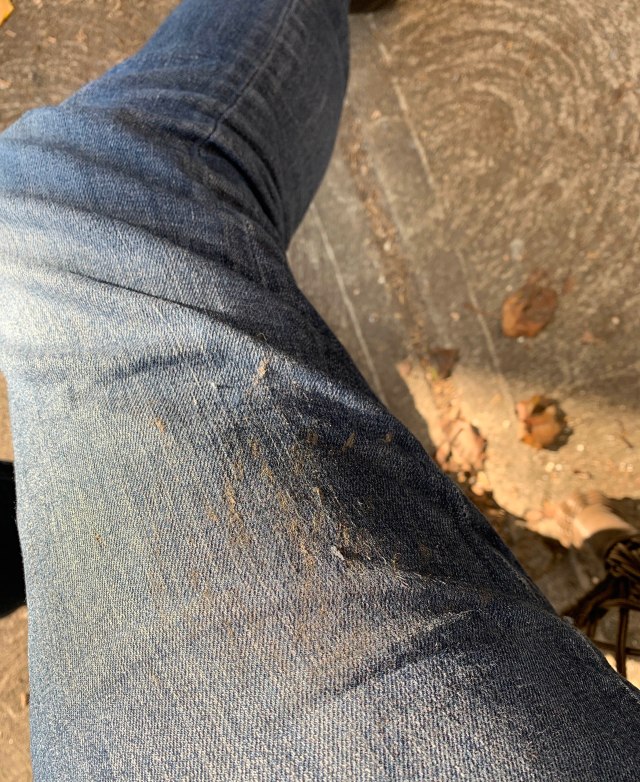
The only problem I encountered was being too stupid to keep a swarf rag handy. Now I have to wash it out of my jeans.

rag

Posted in Uncategorized | 9 Comments

Not Dead Yet!

Bench

My bench and I are happy here.

It has been one year to the day since I got the biggest (thus far) shock of my life. And despite my terror at the time, I’m not dead yet (nor scooping ice cream for a living, as I did when I was 16).

In late 2012, I was promoted to editor at Popular Woodworking Magazine and thought I’d retire from that at age 65 or so; the end came sooner than expected. (And on Dec. 6, 2017, I had the mother of all hangovers – not the best coping mechanism for anxiety and fear, and a terrible waste of good bourbon.) I’d been with Popular Woodworking for 12 years, and with the parent company for 19. When I joined the magazine in 2005, I planned to stay for maybe five years as I earned a Ph.D., then pursue a career in teaching. But to my surprise, I fell in love with woodworking, and sharing woodworking education and information to help people develop skills that translated into tangible objects. I hadn’t thought about a new career – and on the cusp of 50 at the time, how was I going to find one? And did I want to?

I do not do well in a corporate structure. I’ve never been afraid to stand my ground, or speak what I see as the truth to power…but I’ve never learned to do that in a politic manner. While I don’t actually know what led to my leaving, I’m sure my inability to blithely follow directives made the corporate decision easier. And despite feelings of failure, I also felt relief. I was tired of fighting.

So my trepidation notwithstanding, and with the unflagging encouragement and help of Christopher Schwarz and John Hoffman (who have my eternal gratitude), I decided to  stick with the old career, but on my terms.

Thanks to your support I write and edit in my home office, with cats on my lap and in my pajamas if I like; I can pop over to the Lost Art Press shop or my basement shop to build things; I can still pay the mortgage and feed said cats.

Thanks to you, I don’t have to sit in corporate meetings or ever write another employee review; I’ll never ask, “do you want fries with that?”; and I have the luxury of swimming or sinking by my own decisions (and if I do go terribly wrong, well, I can still make a mean milkshake).

Thank you for taking my classes, for reading things I’ve written and edited, for buying books. I tape every package and make every trip to the post office filled with gratitude.

Posted in Uncategorized | 45 Comments

Get ‘Em Started Early

MacI can’t use my bench at Lost Art Press this weekend because we’ve a class going on. I came across the river with thoughts of getting started on the drawers for my built-in – I can mill stock and cut it to size in the machine shop without disturbing the class.

But Monday, I’ve 220 board feet of poplar coming from Frank Miller Lumber to prep for my upcoming Dutch Tool Chest class…and I need 260 board feet or so. I think I have enough in the basement to make up the difference, plus enough for the drawer parts, but better safe than sorry.

So instead, I’m hanging out and reading (it’s warmer here).

Among the many books in what we call the Covington Mechanical Library are some that have been favorites since I was a young kid. I remember reading David Macaulay’s lavishly illustrated books on construction over and again; they gave me dreams of becoming an architect…until I later realized one has to be good at math to be an architect. But they early on instilled in me a fascination with how things are built, which has informed my unexpected career in woodworking and writing about it.

I don’t know if every kid will love them as much as I did (and still do), but if like me you like giving books as gifts, you can’t go wrong with any of Macaulay’s. (Note: His books on construction are also appealing for adults – but his “Motel of the Mysteries” is my favorite for older readers. It tells the story of an year 4022 archeological discovery of a late 20th-century motel (it was buried under junk mail); the explanation of the various finds is hilarious.)

Posted in Books/Editing/Writing, Uncategorized | 7 Comments

New: Rude Mechanicals Press T-Shirts

LogoTypeUpdate_mockup_Front_Flat_Indigo-Blue

I ordered the gray/blue (indigo) for myself…of course (size medium).

You can now order a Rude Mechanicals Press long-sleeved T-shirt from my online store. This cotton T-shirt is available in sizes from small to 5X ($22.50 for S-XL, $2 more for each size up from there, plus $4 shipping). They’re available in white, grey, olive, red, indigo, navy and black.

On the navy and black shirts, there’s not much contrast between the logo and the cotton when the shirt is newly printed – so it’s perfect if you want folks to stare at your chest. But wash it a few times and the shirt color will fade, making the logo stand out more clearly.

Why long-sleeves? Because I like them…and because I’m guessing that like me, most people already have a plethora of short-sleeve T-shirts. Why not also offer a short sleeve version? Because as Jameel Abraham says, you shouldn’t have more wearables than other products – so until my next book is available (2019), I’m at my limit.

These are printed on demand and usually ship in three-four days. (Order now for Christmas.)

Note: Available through the online store only in the U.S.A. for now…but if you live elsewhere and just have to have on, send me an email and I’ll try to work it out.

Posted in Uncategorized | 9 Comments

A Note from the Shipping Manager

JJ_MC

Available with or without cat hair.

In case you are considering a copy of “Mechanic’s Companion” for holiday gift giving: After a grueling computer session (sleeping on the  keyboard for several hours), the RMP shipping manager informs me that the recommended ordering deadline for Christmas delivery (media mail) is no later than Dec. 14 in the lower 48 (and that might be pushing it). And for Hanukkah, were you to order today, your package would likely arrive before the eighth day thereof (sorry…JJ has been slacking in his delivery research duties).


Posted in Uncategorized | 3 Comments

Contemporary Hanging Plate Rack (or Shelves) for Sale

platerack

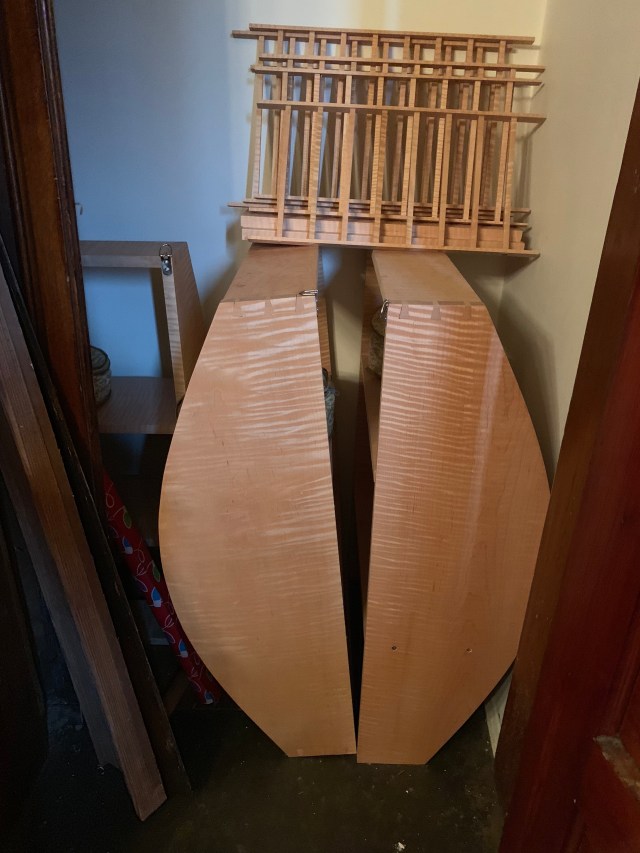
As much as I love the look of this curly maple piece – “Kelly Mehler’s Plate Rack,” which I built in for the December 2013 issue of Popular Woodworking Magazine –  I simply don’t have a suitable place to hang it in my home…so it’s been taking up closet space ever since. I’m hoping someone here wants to give it a good home.

It’s actually three separate dovetailed units, and the plate dividers are simply a friction fit – they are easily removed to use these as hanging shelves instead (but as a plate rack, cup hooks under the center shelf for the middle one might be nice, which is without a bottom shelf so that it fits over a sink).

The top shelves on the two outside units are adjustable; the rest are secured in dados – and I should note that on the center one, there are two screws into the lowest shelf on either side to hold it together (you can see them in the snap below), to allow for the absence of a dovetailed bottom piece. These screws don’t show if they’re hung together, and could be plugged if they’re not. The depth of each is 11-1/4″, the width is 21-1/2″ and the height is 35″. The finish is three coats of satin pre-cat lacquer.

Now I must confess that these are not my best dovetails. I think this was my first dovetailed project in hard maple…and hard maple is, well, hard without some practice. So while I’m not completely displeased with my work from a few feet away, up close, I can see that it is not as perfect as (now) is possible for me – and that’s why I’m willing to re-home the piece(s) for a commensurately low price – $400 (plus shipping, but I’ll deliver for the cost of a decent lunch plus fuel within 125 or so miles of Cincinnati. Or you can pick up and I’ll buy lunch).

If interested, please send me an email.

IMG_0828

As I have them “arranged” in the closet, you can see the two screws on the side of the center unit, and the removable plate dividers. And if you look closely, you can see the sub-perfect dovetails.

And if I can’t find a home for it, in to the “dustbin of history” it goes (as David Savage would say).

Posted in Uncategorized | 2 Comments

In Which I Hope to Not Hurt My Friends

IMG_0813

Apologies in advance to my Thanksgiving guests for the mess – which is going nowhere before Thursday.

As think forward to my front staircase renovation (the bulk of which will come after the sink build), I’m thankful I don’t have to rebuild them from scratch. Still, Peter Nicholson’s words ring true: “…for any error, however small, when multiplied, becomes of considerable magnitude, and even the difference of an inch in the last riser, being too high or too low, will not only have a bad effect to the eye, but will be apt to confound persons not thinking of any such irregularity.”

In other words, if you muck it up, folks will trip – and it is indeed the last (or first, depending on your starting point) riser that’s in play. I have to cut three stringers for the bottom steps, find 1-1/2″-thick 100-year-old Southern yellow pine (60′” long times two) … and I have to do that part soon. (The rail and baluster will continue to wait.)

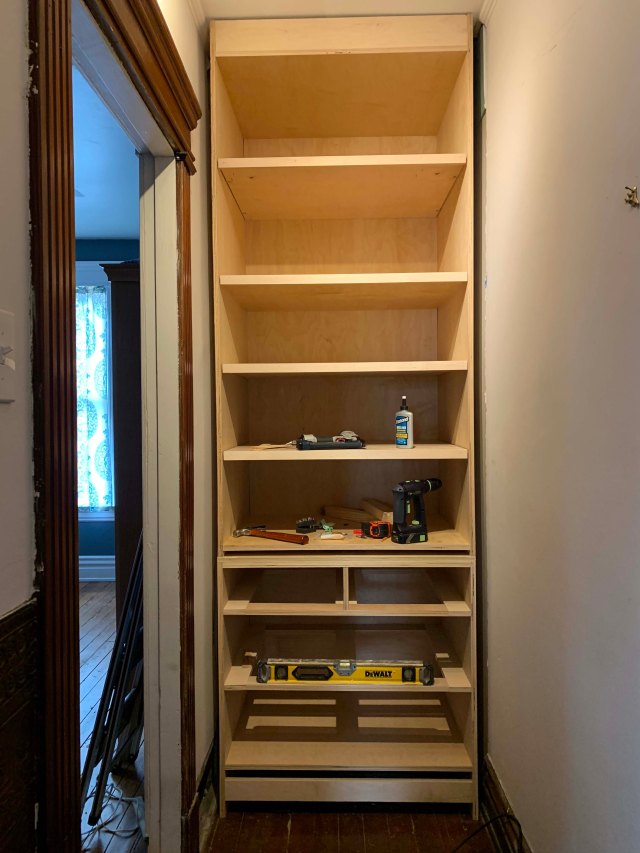
My temporary steps have never been supported at the left end; that extra bit out there is just to help me envision how they will wrap to a built-in bookcase at the front edge of the landing (the paint samples that block that area actually serve a safety function…in addition to displaying my laziness!). And the right end isn’t fully supported, either; the stringer there was either modified during the 1950s remuddling, or it supported a narrow curved return on the bottom stair in the original layout – because it stops well short of the front edge of the tread. So my temp tread has now split.

I know where it’s safe (relatively speaking) to step, so I don’t worry too much about it. But two weeks ago, when Christopher Schwarz helped me fetch, carry and place the hallway built-in carcases, I had horrid visions of one end or the other of that bottom tread snapping off, sending him first to the ground, then to the hospital (though in hindsight, I probably should have worried more about our backs).
IMG_0724

So before that sink base build (because I do not wish to maim my friends), I’ll at least be making those bottom stringers and affixing the permanent treads (drop me a line if you have any thick, long, antique yellow pine available).

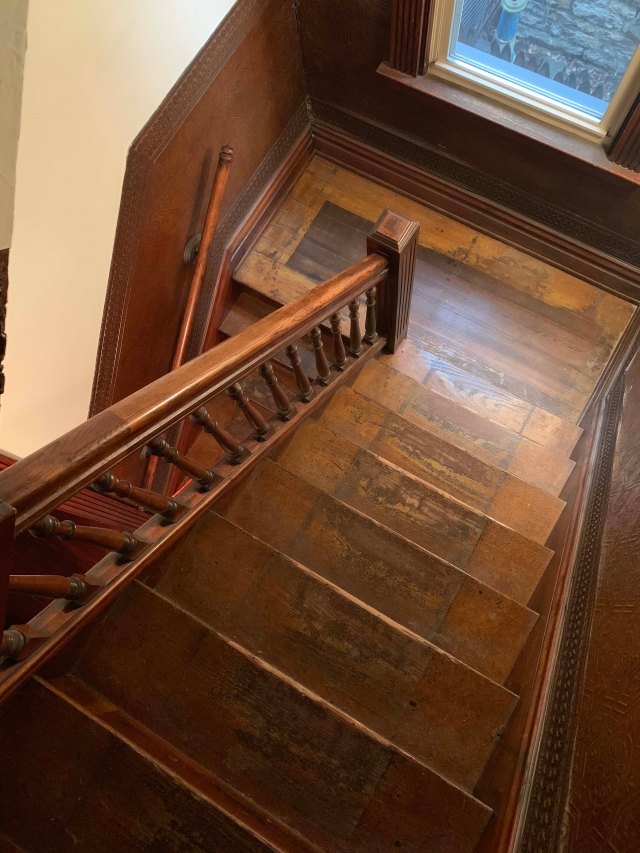
In the meantime (still), all guests must use the back stairs (of, according to Nicholson, the “inferior kind” of dog-leg construction), up which the built-in carcases would have never fit.
IMG_0818

The back stairs also need work – but it’s all cosmetic.

Below is an excerpt from the staircase joinery section of “Mechanic’s Companion,” which explains the difference between “bracket stairs” (my front ones) and “dog-legged” (my back ones). He also writes about “geometrical stairs” – the kind that are far too fancy for my house!

———–

§87. Stairs.
Stairs are one of the most important things to be considered in a building, not only with regard to the situation, but as to the design and execution: the convenience of the building depends on the situation; and the elegance on the design and execution of the workmanship. A staircase ought to be sufficiently lighted, and the head-way uninterrupted. The half paces and quarter paces ought to be judiciously distributed. The breadth of the steps ought never to be more than fifteen inches, nor less than ten; the height not more than seven, nor less than five; there are cases, however, which are exceptions to all rule. When you have the height of the story given in feet, and the height of the step in inches, you may throw the feet into inches, and divide the height of the story in inches by the height of the step; if there be no remainder, or if the remainder be less than the half of the divisor, the quotient will show the number of steps; but if the remainder be greater than the half of the divisor, you must take one step more than the
number shown by the quotient: in the two latter cases, you must divide the height of the story by the number of steps, and the quotient will give the exact height of a step: in the first case, you have the height of the steps at once, and this is the case whatever description the stairs are of. In order that people may pass freely, the length of the step ought never to be less than four feet, though in town houses, for want of room, the going of the stair is frequently reduced to two feet and a half.

Stairs have several varieties of structure, which depends principally on the situation and destination of the building. Geometrical stairs are those which are supported by one end being fixed in the wall, and every step in the ascent having an auxiliary support from that immediately below it, and the lowest step, consequently from the floor.

Bracket stairs are those that have an opening or well, with strings and newels, and are supported by landings and carriages, the brackets mitering to the ends of each riser, and fixed to the string board, which is moulded below like an architrave.

Dog-legged stairs are those which have no opening or well-hole, the rail and balusters of both the progressive and returning flights fall in the same vertical planes, the steps being fixed to strings, newels and carriages, and the ends of the steps of the inferior kind, terminating only upon the side of the string, without any housing. …
190.Join.Plate21.MC095

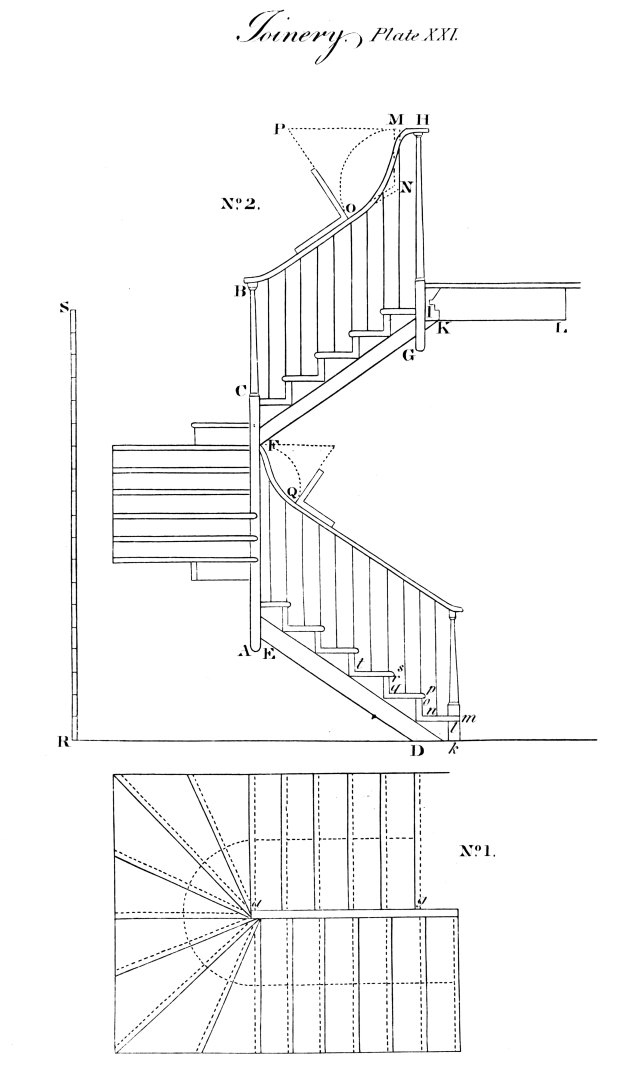
PLATE XXI.
EXPLANATION,
Showing the Construction of a Dog-leg Staircase

No. 1. the plan,
No. 2. the elevation.
A B, No. 2. the lower newel, the part B C being turned
a No. 1. the seat of the newel on the plan.
G H, No. 2. the upper newel.
g, No. 1. its seat on the plan.
D E and F G, No. 2. lower and upper string boards framed into the newels.
K L, No. 2 a joist framed into the trimmer I.
k l, n o, q r, & c. No. 2. the faces of the risers; m n, p q, s t, the treads of the cover boards.
m, p, s, &c. No. 2. the nosings of steps.

The dotted lines on the plan, represent the faces of the risers; and the continued lines, the nosings of the steps.

M O and F Q, upper and lower ramps.

The method of drawing the ramp is as follows: suppose the upper ramp to be drawn; produce the top H M of the rail to P draw M N perpendicular to the horizon, and produce the straight part O N of the pitch of the rail, to meet it in N; making N O equal to N M : draw O P at right angle to O N: from P as a centre, describe the arc M O, and then the other concentric circle, which will complete the ramp required.

R S the story rod ; a necessary article in fixing the steps, for if put up only by a common measuring rule, will frequently occa­sion an excess or defect in the height, so as to render the stair extremely faulty, which cannot be the case, if the story rod is applied to every riser, and the riser regulated thereby. In the aforesaid case, the error is liable to multiply.

 

Posted in Uncategorized | 7 Comments

‘The Chronicle’ – America’s Material Culture History

IMG_0810 copy

My first issue as editor is the one on the far right, with corn-husking gloves on the cover. Do not confuse corn-husking gloves with massage gloves.

With the September of The Chronicle – the journal of the Early American Industries Association (EAIA) – arriving in mailboxes, I’m now at work on the December issue. (My fervent hope is that it actually delivers in December; getting delivery and cover dates to match up is among my goals.)

As a member of EAIA , you get the print journal (The Chronicle) four times a year, Shavings, the quarterly e-newsletter (with information about EAIA meetings and events, tool auctions and more), and a discount on direct purchases from Astragal Press.

The Chronicle offers a wide array of articles on the tools, trades and industries that helped to build America: woodworking; carpentry; textile production; cookery; blacksmithing; farming; clock making; millinery; ice production; luthiery; metal production; glass; coopering; milling; masonry; brick making; brick laying; water delivery; stone cutting; boatbuilding; slating; printing; cheesemaking…the list could go on and on. (I’ve learned a massive amount of fascinating information about our collective material culture history in the last couple of months as I’ve read through back issues!) And if you have scholarly research on any of these topics and more that you’d like to see in print, I’d love to hear from you (either at editor@eaiainfo.org or 1snugthejoiner@gmail.com.)

Here’s a look at what’s inside the September issue, and below that, download Peter Follansbee’s tribute to Jennie Alexander:

TOC_Sept18

Click the link below to download a PDF of “A Greenwood Revolution Legacy:
Jennie Alexander, 1930-2018,” from The Chronicle Volume 71, no. 3.
Alexander


Posted in Uncategorized | 5 Comments

Get Your Dovetails on in Atlanta

I, my tools and a lot of prepped cherry will be traveling to  Highland Woodworking in Atlanta on March 2-3 for a class in hand-cut dovetails – join me!

Here’s the description from the Highland website:

Make a Classic Shaker Tray with Megan Fitzpatrick
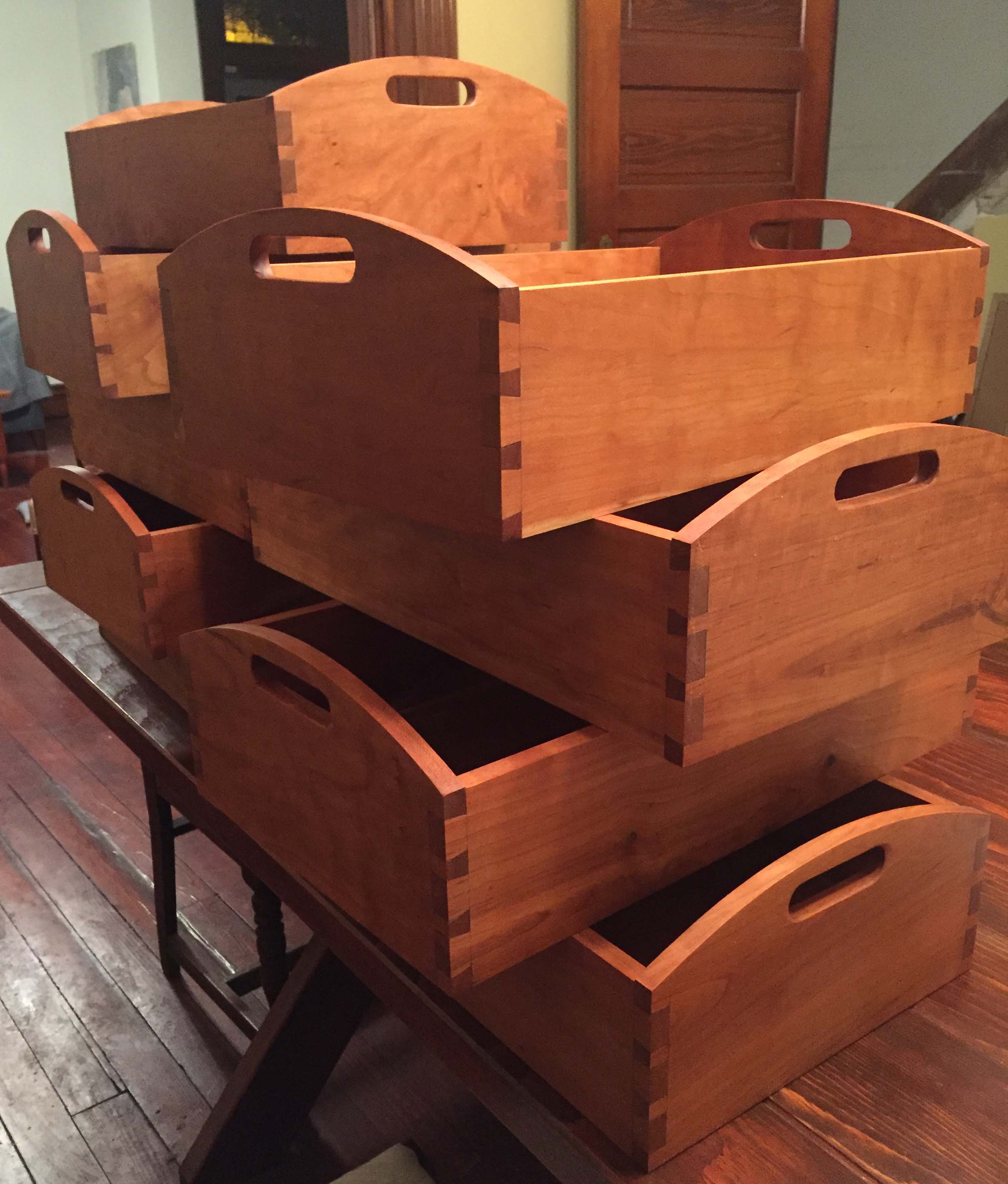
Develop your hand tool woodworking skills building this traditional Shaker Silverware Tray. Megan Fitzpatrick will guide you in the intricacies of crafting dovetails including their layout with dividers, strategies for transferring tails to the pin board, saw and chisel control for cutting and paring to a line, and final joint fit & glue-up. You’ll learn a few tricks along the way for fixing less than sublime dovetails and discover how perfectly imperfect dovetails are still able to stand the test of time. You’ll hand cut the tray ends and hand shape the curves fair. In securing the bottom board, you’ll discover the proper use of traditional tapered, square-shank cut nails. Come let this weekend project with Megan help you refine your hand tool skills to the next level.

Megan Fitzpatrick is the publisher at Rude Mechanicals Press, and is a freelance woodworking editor and writer for Lost Art Press, Mortise & Tenon magazine and more; she is a former editor at Popular Woodworking Magazine. She teaches classes in hand-tool woodworking at schools and workshops throughout the United States, and builds custom furniture.

Registration is now open.


Posted in Uncategorized | 2 Comments

‘Of Saws in General’

Plate13.2400

Below is an excerpt from “Mechanic’s Companion,” by Peter Nicholson (which I dare say would make a lovely holiday gift for the woodworker or tool collector on your list).

  • 45. Of Saws in general. Pl. 13. Fig. 6, 7, 8, 9, 13.

A saw is a thin plate of steel indented on the edge for cutting, by a reciprocal change in the direction of motion, pushing it from. and drawing it towards you. The cut which it makes, or the part taken away in a board, is a thin slice, contained between parallel planes, or a deep narrow groove of equal thickness. Saws are of several kinds, as the ripping saw, the half ripper, the hand saw, the panel saw, the tenon saw, the sash saw, the dove-tail saw, the compass saw, and the key-hole or turning saw. The teeth of these saws are all formed so as to contain an angle of sixty degrees, both external and internal angles, and incline more or less forward as the saw is made to cut transverse to, or in the direction of the fibres: they are also of different lengths and breadths, according to their use. The teeth of a saw are bent alternately to each side, that the plate may clear the wood.

  • 46. The Ripping Saw

Is used in dividing or slitting wood in the direction of the fibres; the teeth are very large, there being eight in three inches, and the front of the teeth stand perpendicular to the line which ranges with the points: the length of the plate is about twenty eight inches.

  • 47. The Half Ripper

Is also used in dividing wood in the direction of the fibres: the length of the plate of this is the same as the former, but there are only three teeth in the inch.

  • 48. The Hand Saw, Pl, 13. Fig. 6.

Is both used for cutting the wood in a direction of the fibres and cross cutting: for this purpose the teeth are more reclined than the two former saws: there are fifteen teeth contained in four inches. The length of the plate is twenty six inches.

  • 49. The Panel Saw

Is used for cutting very thin wood, either in a direction of, or transverse to the fibres. The length of the plate is the same as that of the hand saw, but there are only about six teeth in the inch. The plates of the hand saw and panel saw are thinner than the ripping saw.

  • 50. The Tenon Saw, Pl. 13. Fig. 7.

Is generally used for cutting wood transverse to the fibres, as the shoulders of tenons. The plate of a tenon saw is from fourteen to nineteen inches in length, and the number of teeth in an inch from eight to ten. As this saw is not intended to cut through the wood its whole breadth, and as the plate would be too thin to make a straight kerf, or to keep it from buckling, there is a thick piece of iron fixed upon the other edge for this purpose, called the back.

The opening through the handle for the fingers of this and the foregoing saws is inclosed all round; and on this account is called a double handle.

  • 51. The Sash Saw, Pl. 13. Fig. 8.

Is used by sash makers in forming the tenons of sashes: the plate is eleven inches in length. The inch contains about thirteen teeth; this saw is sometimes backed with iron, but more frequently with brass.

  • 52. The Dove-tail Saw

Is used in dove-tailing drawers. The length of the plate is about nine inches, and the inch contains about fifteen teeth. This plate is also backed with brass. The handles of the two last saws are only single.

  • 53. The Compass Saw, Pl. 13. Fig. 9.

Is for cutting the surfaces of wood into curved surfaces: for this purpose it is narrow, without a back, thicker on the cutting edge, as the teeth have no set. The plate is about an inch broad, next to the handle, and diminishes to about one quarter of an inch at the other extremity; here are about five teeth in the inch. The handle is single.

  • 54. The Key-hole, or Turning Saw

Is similar to the compass saw in the plate, but the handle is long, and perforated from end to end, so that the plate may be inserted any distance within the handle. The lower part of the handle is provided with a pad, through which is inserted a screw, for the purpose of fastening the plate in the handle: this saw is used for turning out quick curves, as key-holes, and is therefore frequently culled a key-hole saw.

Posted in Uncategorized | Leave a comment