Woodworking in Literature (or, The Lazy Researcher)

JointStool

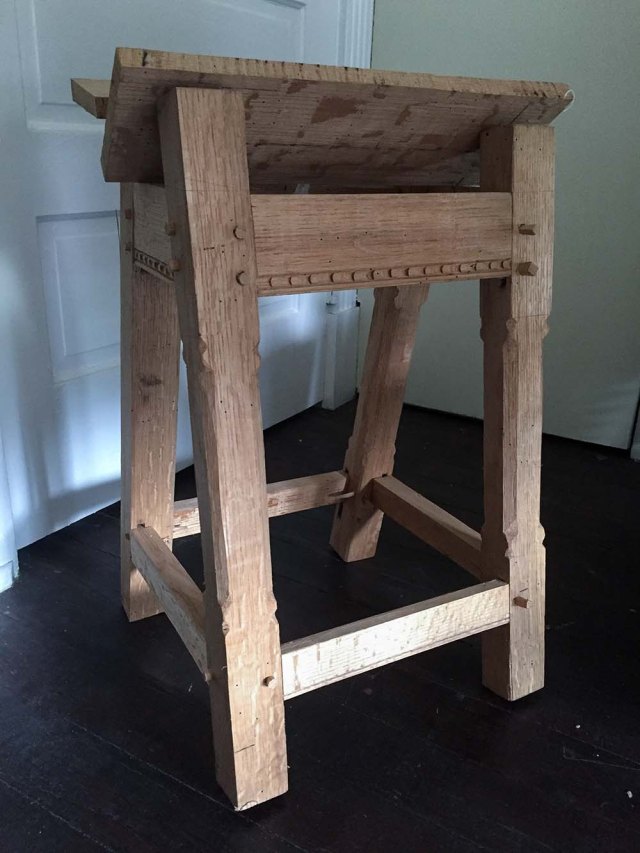
An almost-finished joint stool…that has been almost-finished since 2011…

In “The Taming of the Shrew” Katherine calls Petruchio a “joyn’d stool,” to which he responds in a less-than-gentleman-like manner: “Thou hast hit it: come, sit on me,” among other salacious riposts that devolve into talk of tongues in tails. (A stool also appears in “King Lear,” “A Midsummer Night’s Dream,” “Macbeth,” “Romeo and Juliet” and “2 Henry IV.”) There are handsaws in “Hamlet,” and crowbars in “Comedy of Errors (though for unmaking, not making).

In “The Odyssey,” Odysseus carves a bed from a living olive tree then builds the bedroom around it: “…cut away the foliage of the long-leaved olive,/and trimmed the trunk from the roots up, planing it with a brazen/adze, well and expertly, and trued it straight to a chalkline,/making a bed post of it, and bored all holes with an auger.”

In Adam Bede, the title character is a carpenter; in “Madame Bovary,” Monsieur Binet spends his time making useless things on the lathe.

Woodworking also shows up in such pre-20th-century literary works as the poetry of Walt Whitman, Thomas Dekker’s play “The Roaring Girl,” Herman Melville’s “Moby Dick,” Christopher Marlowe’s “The Jew of Malta,” Ben Jonson’s “Eastward Ho,” and “The Epic of Gilgamesh.” And I think it’s woodworkers who start a riot at Lamarque’s funeral in “Les Miserables” – though I’m dreading re-reading Hugo to confirm that (it’s perhaps shameful, but I never could appreciate his novels).

I’m looking for more, in relation to a project on woodworking or woodworkers that appear in pre-20th-century adult literature (that is, not fairy tales or other children’s literature)…and I’m afraid I’ve forgotten some important one such as, I dunno, the Bible.

If any references spring to mind, please help me out by posting a comment below.

Edit: And “Robinson Crusoe,” as I was just reminded by the Saucy Indexer – I knew there was at least one major one I was forgetting!

Posted in Books/Editing/Writing, Mortise & Tenon Magazine | 25 Comments

Owner’s Signatures

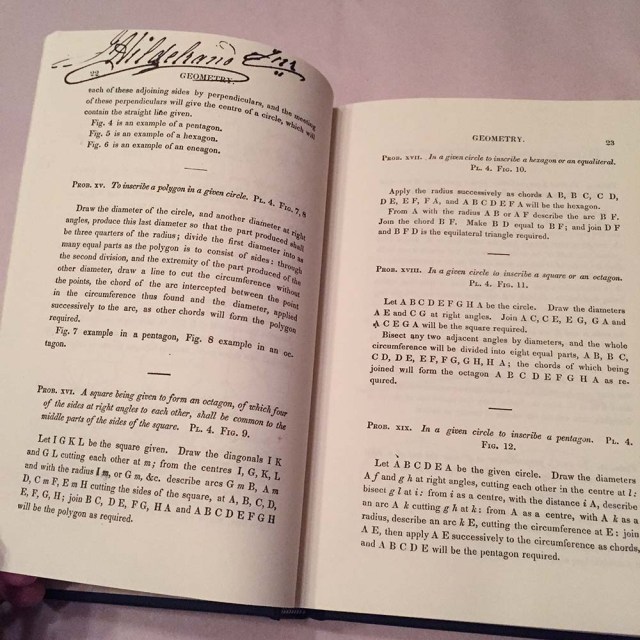
H2Leaf through “Mechanic’s Companion,” and you’ll find a signature at the top of some of the pages. Those are, I assume, the signature of the original owner (J. Hildebrand?) of the book I scanned to produce my printing.

So why didn’t I clean those up (i.e. erase them) as I was working on all the foxing? Well, I think they’re charming – and they don’t interfere with legibility, so I left them.

Today, it is more common to use a bookplate or sign one’s copy in the front of ones books to identify the owner. But it was fairly typical at one time to sign multiple times, and on the same pages in every book in one’s library. That way, if the cover and end sheets were damaged or removed, one could turn to the chosen pages and know to whom it belonged. A borrower (or thief) would be less likely to remove pages with necessary information!

H1


Posted in Uncategorized | 10 Comments

‘Mechanic’s Companion’ in Brooklyn & Canada

turningplate

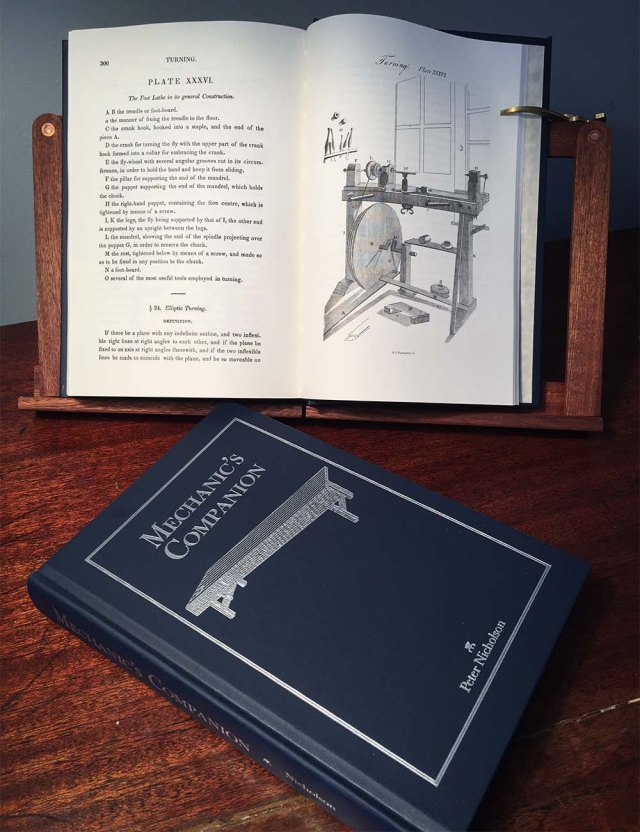
I’m pleased to announce that soon, “Mechanic’s Companion” will be available through Tools for Working Wood in Brooklyn, N.Y., and its website and at Lee Valley Tools stores in Canada and the company’s online store. Both also ship international. (I shipped boxes to TFWW yesterday, and am expecting a pickup for LV today.) Plus, I’m awaiting orders from a couple of other stockists (yes, I used “stockists” to elicit an eyeroll from Christopher Schwarz): one in England and one on the Continent. I’ll post updates when I get those, and add them to the “Where to Buy” page at rudemechanicalspress.com.

Posted in Uncategorized | 6 Comments

‘The Workbench,’ à la Nicholson

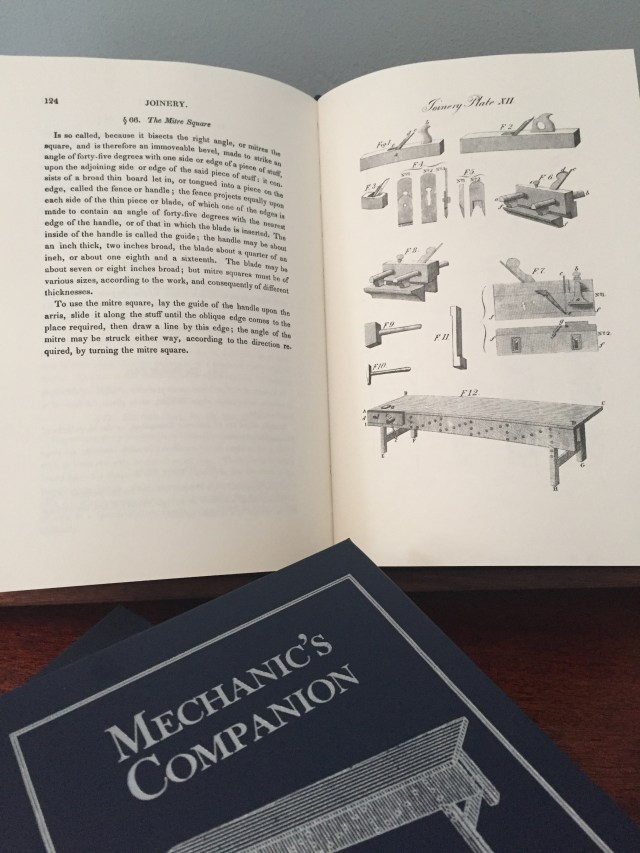
IMG_8636Last week, 99 boxes of “The Mechanic’s Companion” arrived on my sidewalk, and one by one, I hauled about one-quarter of them up the stairs and into the house. Two by two, Christopher Schwarz hauled in the other three-quarters. (He is strong and generous.) I taught a class over the weekend, so I wasn’t able to get pre-publication orders packaged, addressed and in the mail until yesterday and today – but I’m delighted to report they’re now all on their way. And I’m ready to ship to select international and domestic retailers with whom I’ve talked about carrying it – more on who they are as I get those orders confirmed. (I do, however, have plenty remaining should you wish to order a copy.)

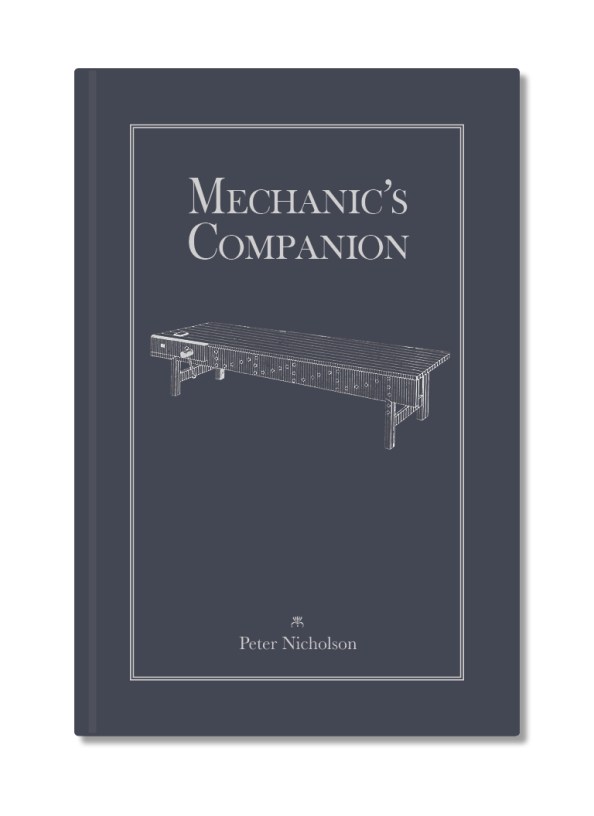
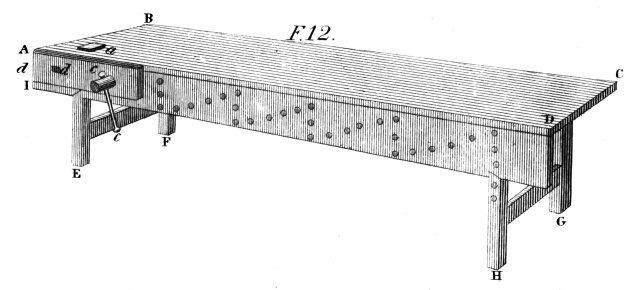
The die-stamp image on the book’s cover is the bench (with some of the lines removed so as to make a crisp stamp); it’s the first tool about which Peter Nicholson writes in his joinery section:

§ 2. The Bench. Pl. 12. Fig. 12.
Consists of a platform A B C D called the top, supported upon four legs, E, F, G, H. Near to the further or fore end A B is an upright rectangular prismatic pin a, made to slide stiffly in a mortise through the top. This pin is called the bench hook [planing stop], which ought to be so tight as to be moved up or down only by a blow of a hammer or mallet. The use of the bench hook is to keep the stuff steady, while the joiner, in the act of planing, presses it forward against the bench hook. D I a vertical board fixed to the legs, on the side of the bench next to the workman, and made flush with the legs: this is called the side board [vise]. At the farther end of the side board, and opposite to it, and to the bench hook, is a rectangular prismatic piece of wood b b, of which its two broad surfaces are parallel to the vertical face of the side board: this is made moveable in a horizontal straight surface, by a screw passing through an interior screw fixed to the inside of the side board, and is called the screw check [vise chop]. The screw and screw check are to­gether called the bench screw; and for the sake of perspicuity, we shall denominate the two adjacent vertical surfaces of the screw check, and of the side board, the checks of the bench screw. The use of the bench screw is to fasten boards between the checks, in order to plane their edges; but as it only holds up one end of a board, the leg H of the bench and the side board are pierced with holes, so as to admit of a pin for holding up the other end, at various heights, as occasion may require. The screw check has also a horizontal piece mortised and fixed fast to it, and made to slide through the side board, for preventing it turning round, and is therefore called the guide.

Benches are of various heights, to accommodate the height of the workman, but the medium is about two feet eight inches. They are ten or twelve feet in length, and about two feet six inches in width [about 12″ wider than my bench!]. Sometimes the top boards upon the farther side are made only about ten feet long, and that next the workman twelve feet, projecting two feet at the hinder part. In order to keep the bench and work from tottering, the legs, not less than three inches and a half square, should be well braced, particularly the two legs on the working side. The top board next to the workman may be from one and a half to two inches thick: the thicker, the better for the work; the boards to the farther side may be about an inch, or an inch and a quarter thick. If the workman stands on the working side of the bench, and looks across the bench, then the end on his right hand is called the hind end, and that on his left hand the fore end. The bench hook is sometimes covered with an iron plate, the front edge of which is formed into sharp teeth for sticking fast into the end of the wood to be planed, in order to prevent it from slipping; or, instead of a plate, nails are driven obliquely through the edge, and filed into wedge-formed points. Each pair of end legs are generally coupled together by two rails dove­tailed into the legs. Between each pair of coupled legs, the length of the bench is generally divided into three or four equal parts, and transverse bearers fixed at the divisions to the side boards, the upper sides being flush with those of the side boards, for the purpose of supporting the top firmly, and keeping it from bending. The screw is placed behind the two fore legs, the bench hook immediately before the bearers of the fore legs, and the guide at some distance before the bench hook. For the convenience of putting things out of the way, the rails at the ends are covered with boards; and for farther accommodation, there is in some benches a cavity, formed by boarding the under edges of the side boards before the hind legs, and closing the ends vertically, so that this cavity is contained between the top and the boarding under the side boards; the way to it is by an aperture made by sliding a part of the top board towards the hind end: this deposit is called a locker.
bench2

book covers


Posted in Uncategorized | 18 Comments

‘What’s With the Weird Cat Logo?’

FinalLogo“What’s with the weird cat logo,” asked someone on Sunday – and I have received other iterations of said question in the last seven months.


In short, as you might know, I love both cats and woodworking, and while it might not be readily apparent, my cat logo covers both.

As I was thinking about a suitable logo years ago, I racked my brain for something that said “woodworking” at a glance. I collect small glue pots, so that seemed a possibility. But a drawing of a glue pot could just as easily be read as a cooking pot…or an unidentifiable object, given its two handles. So I considered Joseph Moxon’s brace drawing, but it’s used on the cover of the Lost Art Press book “The Art of Joinery,” and the Lost Art Press dividers (aka “a pair of compasses”) logo is also from Moxon. Goodness knows I’m already completely indebted to Christopher Schwarz and John Hoffman – I had no wish to borrow/steal/copy even more. So I stopped looking, and used only type. After all, I was using my LLC entirely for freelance work (which I wasn’t actively seeking at the time), so I bought the font 17th C Print (because Shakespeare), wrote out “Rude Mechanicals Press” and futzed around with the spacing a bit, then called it a day.

But when my world changed in December 2017, I had to rethink things. I mean…what’s a publishing company (however small) without a logo? Something has to go on the bottom of the book spine! (It doesn’t, actually.)

So I turned to my favorite page (because cat) in “The Practical Woodworker”…

PWW_Original_Catscan

…scanned and isolated the stylized animal…

catscanround


…posterized it…

catscanposterized

Then cleaned it up and removed almost all of the hatching (shown at the top of this post), because it would unfortunately not replicate well rendered small (say, on the spine of a book). I rather love the hatching, though – I might keep it if in the future I need a larger logo.

And soon, thanks to Andrew Brant, I’ll have a vector file that’s cleaned up more, with even line weights and smoother curves, so I can then order a small stamp for my furniture work. My logo – obscure though it may be – is far more easily parsed than my scrawl of a signature.

Related: “I, one Snug the Joiner…”

Posted in Books/Editing/Writing, Rude Mechanicals Press | 12 Comments

‘Mechanic’s Companion’ Arrives This Week

MCOnlineCover

I’m told by my printer that “The Mechanic’s Companion” will leave the plant tomorrow to head toward my warehouse (a.k.a. my dining room) in Cincinnati. As soon as the boxes arrive, I’ll start shipping out all the pre-publication orders in the order they were entered. And given that my cats are no help at all, please bear with me as I wrap, pack and mail them (but I’ll get it done quickly – I promise)!

If you haven’t yet ordered, rest assured there are still some first-run copies available. (I’ll be building a cat mansion out of the back-stock boxes…but I’d be delighted were it instead a cat tiny house). The book is $34, which includes domestic shipping; it can be ordered here.


I will also have copies available at the Lie-Nielsen Open House in Warren, Maine, on July 13-14, and possibly be selling them out of the back of my car (psssstttt buddy….wanna buy a woodworking book?) at the August 11 Lost Art Press open house…unless Chris takes pity on me and allows me to bring them inside. (The latest Lost Art Press book, John Brown’s “Welsh Stick Chairs” is also shipping from the printer this week.)

And, I’m working with a handful of partners (both U.S. and international) – as soon as I have orders confirmed, I’ll let you know where else you can find the book.

weather

It is a fact universally acknowledged that it always rains on delivery day.

Posted in Uncategorized | 4 Comments

‘The Rules,’ According to David Savage

Savage

Editor’s note: I’m working flat out this week to get all the images sorted for David Savage’s forthcoming book “The Intelligent Hand,” coming this fall from Lost Art Press. Both Christopher Schwarz and I have completed line edits, so it now needs to go into design ASAP to meet the publication date. Though the typical Lost Art Press deadline is “when it’s ready,” this one must not only be ready, but be done soon; we promised David it would be. So it will be.

I have carried around in a notebook and added to these quotations for most of my life, I have found them inspirational. I hope they may be of some help to you, on your special journey.

1. Have a plan, but like all good battle plans, do not expect it to survive first contact with the enemy.
2. Make lots of lists; the older you get, the more you need to write it down. Don’t clutter your head with stuff you don’t have to remember. Write it down. Feeling listless? Then make a list.
3. Do not believe everything your oncologist tells you.
4. When it comes to critics and criticism, remember Theodore Roosevelt. Forgive the sexist language but bear in mind when this was written:
“It is not the critic that counts, not the man who points out how the strong man stumbles, or where the doer of deeds could have done them better. The credit belongs to the one man who actually is in the arena. Whose face is marred by dust and sweat and blood. Who strives valiantly. Who errs and comes short time and again, for there is no effort without errors and shortcomings . He who knows the great devotion, who spends himself in a worthy cause, who at best knows in the end high achievement and triumph, who at worst knows failure whilst daring greatly. He knows that his place will never be with those timid and cold souls who know neither victory nor defeat.”
5. All goals and dreams are useless without a plan – a plan that can put those goals into a time frame to allow you to take action. Break the big task into smaller ones. You eat the elephant a bite at a time
6. Without goals and dreams we live a miserable life.
7. “On obstacles” by Henry Ford: “These are what you see when you take your eye off the goal.”
8. “An education is what is left when you have forgotten everything you learnt at school.” – Samuel Johnson.
9. “The most important thing that one must learn, first of all, is what the rules are. Before one can then disregard them.” – Elizabeth David
10. “The fragrance of the rose lingers upon the hand that casts it.” – William Shakespeare
11. “Do you want to succeed? Then you must double your rate of failures.” – Tom Watson, IBM
12. “A man without a smile should not keep a shop.” – Chinese Proverb
13. “What you can do, or dream that you can, begin it. Boldness has magic and power and genius within it.” – Goethe
I have been witness to this countless times. A prospective student takes the jump, fearful and anxious of what the future may hold, she makes a commitment to changing her life. The moment this happens all sorts of life changes fall in behind that decision to make it work. Goethe was right, big time.
14. “The laws which define the structure and dynamics of the universe must become part of our awareness. For these are the same laws which determine the structure and dynamics of the body. The spirit that moves an atom waves the sea.” – Ueshiba, inventor of Aikido
15. “Knighthood, Peerage, the trappings of wealth power and position, all of which I love. I would give them all up for a conductor’s baton, to be able to make first-class music, to have that talent.” – Arnold Winesteen Chairman of GEC
16. “You think that you make the piece of work, but really, the piece makes you.” – David Binnington Savage

Posted in Uncategorized | 8 Comments

Last-minute (Almost) Opening in Tray Class

planning

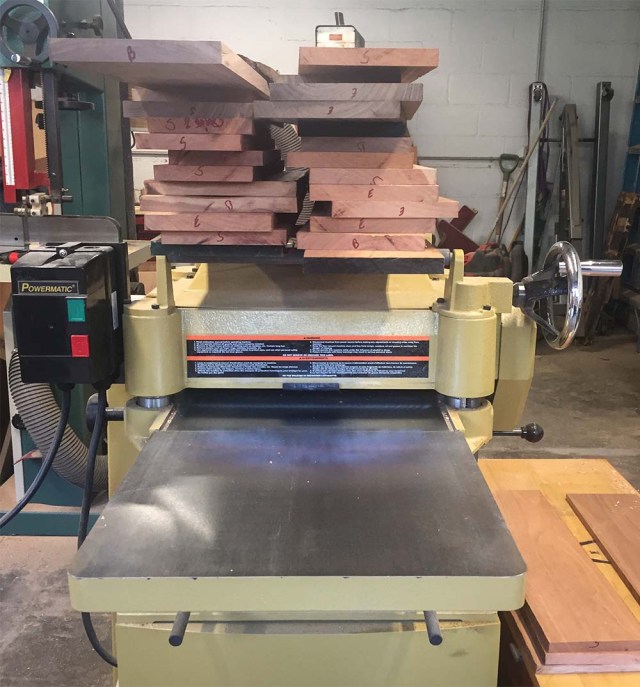
This is the semi-fun part – the stock selection.

Are you free next weekend and want to learn to cut dovetails – and have a great time doing it? Due to an injury, one of the six students (low teacher-to-student ratio!) for next weekend’s Dovetailed Silverware Tray Class has to postpone, so I’ve an opening. The class runs 9 a.m.-5 p.m. June 25-26, at the Lost Art Press shop, 837 Willard St., Covington, Ky.

The stock for this opening is cherry, lovingly chosen and prepared by me (and with only a single splinter  suffered in the process – a new record!)

stockprep

The not quite as fun (for me) part – the stock prep.

You’ll learn:

  • Dovetail layout using dividers
  • How to use a backsaw to saw to a line
  • How to wield a coping or fret saw
  • How to pare and chop to a line with a chisel
  • Strategies for transferring the tails to the pin board
  • Techniques for fitting the joint
  • How to lay out then cut and fair the handles (both the hand holds and the curved top edge)
  • How to smooth-plane your surfaces
  • How to use cut nails (to secure the bottom board)
  • And of course, how to put it all together (and why I recommend liquid hide glue).
trays

The really fun part – making these!

Posted in Uncategorized | Leave a comment

Come Say Hello in Maine – July 13-14

LNFrontI’ll be at the Lie-Nielsen Toolworks Open House in Warren, Maine, July 13-14 with lukewarm-off-the-press copies of “The Mechanic’s Companion” for sale (it ships to me in Cincinnati the week of June 18 or 25) or, and to give a short talk Sunday afternoon on woodworking and social media (#takegoodpictures #shareuniqueprojects #gethiredtowriteanarticle #catvideos).

I’m driving up … and wondering if I can do it all in one day (I suspect not), and camping (I think) on site, or possibly in my car (#subaruforthewin). Until night two, when I decide I need a shower (or perhaps I’ll just buy a new ball cap – if you see me on Sunday, you’ll know which). I’m not sure yet who else will be there as guest demonstrators, but I plan to take a tool or two and make a little something on site.

Below are just a few of my favorite snaps from past open houses – it’s a lot of fun, and highly recommended! The open house proper is free and runs both days from 9 a.m.-5 p.m. – plus there’s an optional Saturday night lobster dinner ($45) with a keynote address by Thomas Moser; as I write this, there are still tickets remaining. Thos. Moser gave the keynote at the 2009 Woodworking in America (or was it 2010?) and he was very good indeed!

FS

Frank Strazza cutting some sliding dovetail joints.

PG

Peter Galbert

PLandIS

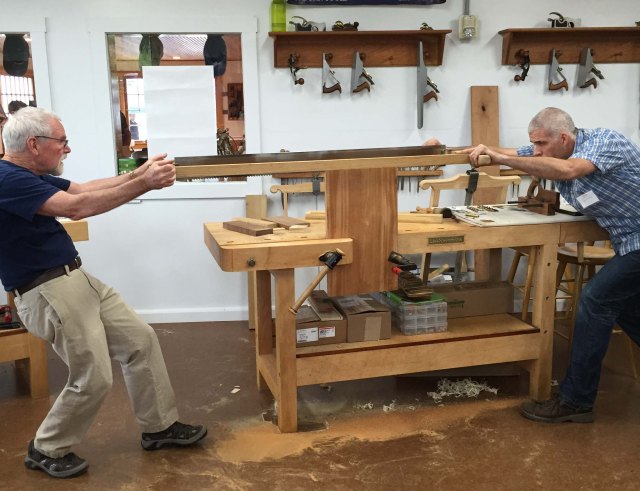
Phil Lowe and Isaac Smith demonstrating Isaac’s Roubo Frame Saw

MM

Mary May

TLN

Thomas Lie-Nielsen laughing (during Peter Follansbee’s 2014 talk)

DTC

A Dutch Tool Chest Christopher Schwarz made during the 2014 Open House; Peter Follansbee carved the fall front, then I painted it. I think we then planed off the top of the panel to leave black paint only in the carved areas…or we at least talked about it.

CM

Claire Minihan, hooking ’em in early to hand tools

PFandDP

Peter Follansbee and Deneb Puchalski

p.s. I’ll be back at Lie-Nielsen in early September to teach a dovetails/tray class…I hope! (Need a few more people to sign up, and to tell friends to sign up, too!)

Posted in Uncategorized | 5 Comments

Travelin’ ATC: Interior Designs Needed

Chest

By last Friday at the Port Townsend School of Woodworking, most people got about as far as shown above on their chests – which is awesome. And a couple folks finished the lids completely, which is amazing, because…everyone was so far ahead of plan that I got a wild hair up my youknowwhat on Thursday and decided we’d do the lids by hand: hand-cut grooves for the rails, stiles and panels (yay – grooves in end grain!), hand-chopped 3″-deep mortises and hand-cut haunched tenons. My plan had been to run the lid joinery (and the rabbets for the shiplapped bottom boards) by machine, then send everyone home ready to do the interiors. But these guys were so fast!

Should I have stuck to my plan? Perhaps – but I didn’t want folks to be bored, and there was time enough to learn some new skills (plus hand-cut tenons are fun)! And everyone who still needs to knows how to complete the lids at home.

angle

pssst…don’t forget that angle cut on the back ends of the lid’s dust seal!

So now, I’m working on suggestions for the interior, based on Christopher Schwarz’s blog post here, and his article in the August 2015 issue of Popular Woodworking Magazine, and recommendations on paint (milk paint – either real or faux), hinges (I’m partial to  the Horton Brasses PB-407 in nickel) and lifts (these cast iron ones from Lee Valley Tools) to send out to the 10 students.

But if you’ve made a small version of the Anarchist’s Tool Chest and deviated from the plans, I’d love to see what you did, so I can share options. For example, I changed the saw storage and tool rack in my full-sized “Anarchist’s Tool Chest” from what Chris showed in his book. (It’s one of the few times I have, in fact, “disobeyed him” – and I’m glad I did.)

rack copy

I added a row of slots behind the chisel rack for backsaw storage, and my tills are slightly narrower front to back than what’s shown in “The Anarchists’s Tool Chest”…

Saws

…and my panel saws are stored on the lid.

So if you made similar changes (again, to the smaller version of the chest), please send me snapshots in an email, to 1snugthejoiner@gmail.com; I’ll put together a post (with credit, of course!) when I have a few, and add to it as more come in.

P.S. A happy birthday to one of my best friends – without whom I would not know how to clock a screw, sharpen a plane blade or chisel, flatten a board, edit a woodworking article, enjoy beer, build a tool chest…

Posted in Uncategorized | 2 Comments