Changes (Good Ones) for Me

Jones

“Cut & Dried: A Woodworker’s Guide to Timber Technology” by Richard Jones. After editing the last few chapters on Sunday, I handed off the binder yesterday to Kara Gebhart Uhl, the managing editor on this project.

I enjoyed a delightful lunch yesterday (Otto’s – yum) with Christopher Schwarz and Kara Gebhart Uhl as we discussed changes at Lost Art Press (LAP), about which Chris posted yesterday on his blog. I’ve copy edited books for LAP for more than a decade, tucking that work into my available time – so late nights and weekends. Now, I’ll be doing that and more during the work day and work week…but I expect I’ll still work a lot of late nights and weekends; it’s in my nature.

I’ve been working pretty much non-stop since I was 16; this year, I’m turning 50. I’ve had many bosses in my 30+ years of employment, and Chris has been by far the best among them. We share a lot of the same interests (I like Shakespeare quite a bit more than does he, and he likes Russian novels; I do not. But that’s a minor disagreement), the same work ethic (though he has more energy) and many of the same ideas about how things should be done (most of which I learned/stole from him).

Now, I’m working with Chris again more closely, and I could not be more grateful to him and John Hoffman for it, and to Kara for welcoming my increased involvement.

But I don’t actually have a new boss, per se (unless you count my cats…who have long had that role); I get to work not with my boss, but with my good friend. When Chris left corporate America, he vowed to never again have or be an employee, and I wholly empathize. The small but dedicated cadre of editors, designers and researchers who work with John and Chris at LAP are freelancers/contractors. I’m happy to have more freelance work that I love, and glad that my increased involvement will free up Chris to research and write more – from that, we all will benefit.

In addition to my work with LAP, I’ll still be writing (it’s weird to be on the other side of pitches after 12 years as a magazine editor!), building furniture, teaching and doing other freelance editing (including an expanded role at Mortise & Tenon Magazine, for which I’m also thankful), along with a few personal projects that have long been on the back burner.

That door closing/opening saying? While I can’t bring myself to willfully use a cliché, that one would be apropos.


Posted in Books/Editing/Writing, Lost Art Press | 14 Comments

Smacked by the Stupid Stick

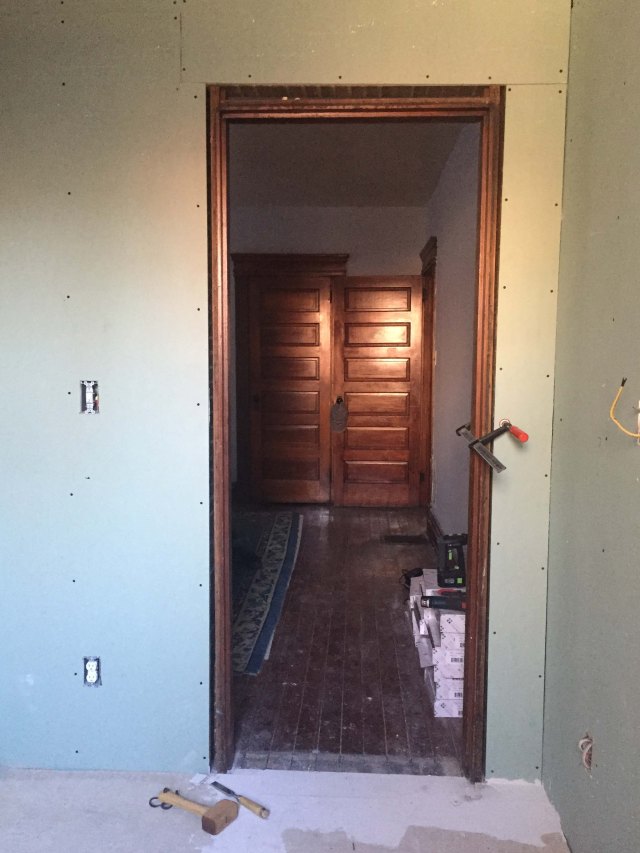
doorway

It is with much chagrin that I share an old-house renovation lesson that I’ve just learned the hard way.

Today, my floor tile arrived. In prep for that installation, I need to install in the new doorway from my bedroom to the bathroom the jamb and stop assembly I removed from the former doorway from the hall. When I carefully removed it from its former location, I thought I was being really smart – it should be a perfect fit because I cut then framed the new opening at the exact same size. (And that will in turn make hanging the door a lot easier, given that it’s hung on that exact jamb since 1906.)

So I grabbed my hammer and a box of nails, and …dammit.

I was right that the jamb would be a perfect fit in the frame. But it’s too deep by about half the thickness of the plaster, plus the thickness of lath, that I removed.

I suppose I should have left as much lath in place as possible, and used thicker drywall for that wall. Or just used much thicker drywall.

Ah well. I’ll now have to add filler strips behind the bathroom-side casing so that it sits flush to the wall and jamb. I flushed the jamb to the other side, where the plaster is still at least semi-intact. I’m hoping the casing (also carefully removed from its former location) will cover up the bits there that are the “semi” of “semi-intact.”

Lesson learned. But I’ll likely forget it by the time I get around to the kitchen remodel.

p.s. See those pine 6-panel doors at the back of the picture? If anyone who lives w/in 200 miles or so of Cincinnati has the same (32″ x 83″, yellow pine, not covered with multiple paint layers) languishing in a basement or attic and wants them gone – let me know! I need a few more, and 6-panel doors of the right size and finish have proven devilishly hard to find in their original-ish state. Hoping to not have to strip…

Posted in Baths, Renovation/Restoration | 13 Comments

Built-in Linen Closet

hallway

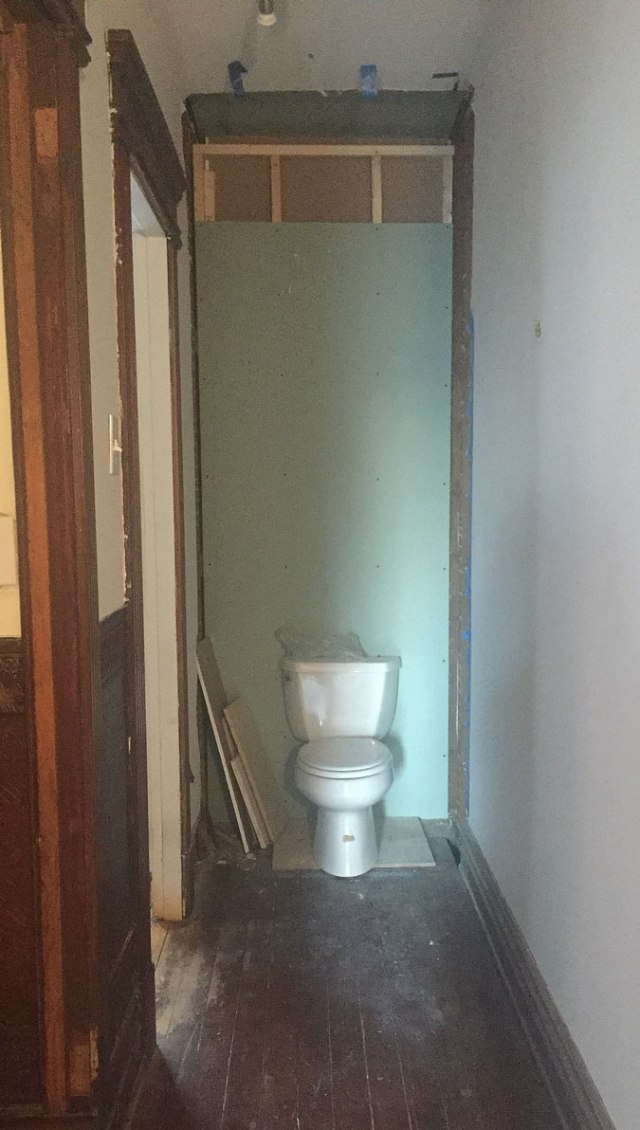
It’s a look.

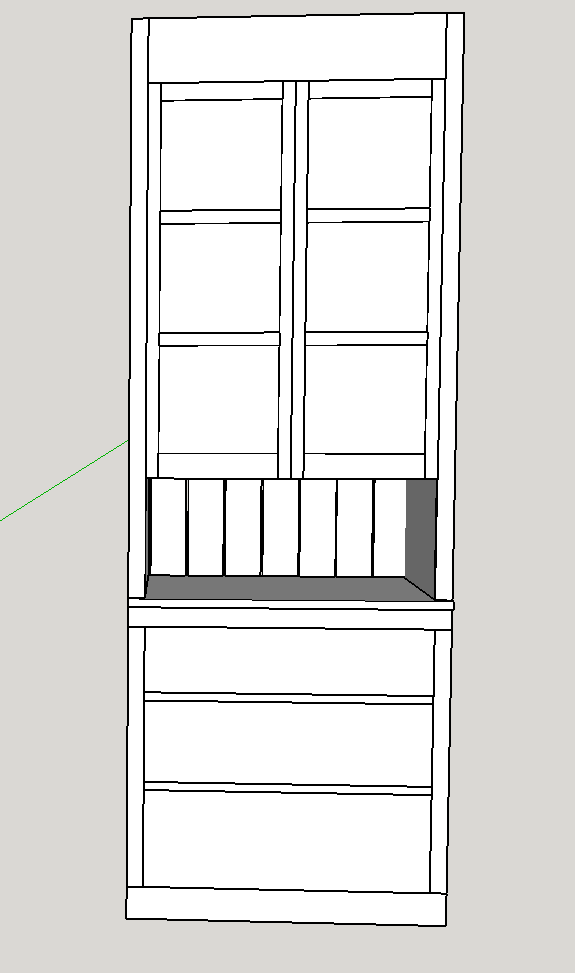
After tucking my new shower into what was a closet and part of  hallway, I’m left with dead-end space about 36″ deep in front of the shower wall (in which a toilet is temporarily being stored). That space is destined to become a 32″-deep built-in linen closet, so today, I drew up a rough design.

The top section has adjustable shelves, with three graduated drawers below and a counter that sticks out about 1-1/2″  between the two sections. The cabinet proper will be 34-1/2″ wide, with a 2″ face frame on either side; the face frame will be scribed to the walls. Below the counter, I’ll apply the same moulding that’s beneath the window sills in the house; the top will get the same applied mouldings as the door to the left, with about 1/2″ above that I’ll scribe to the ceiling. I was too lazy to draw the mouldings in my SketchUp model…or to fix that pesky 11-63/62″ measurement on the bottom drawer.

I know the bottom two drawers in particular are verging on awfully big, but they’re for towels and sheets – and I need the room. They’ll be supported on web frame, with a central member so as to have adequate support.

Screen Shot 2018-01-28 at 2.07.22 PM

I also didn’t draw in the hardware – but I’ll use period-appropriate bin pulls on the drawers, with applied hinges and a cabinet latch on the doors – pretty much like the image below.

Screen Shot 2018-01-28 at 3.01.22 PM

The inspiration, dug up from a real-estate listing. (That carpet…oof.)

To save money and to make the build a little easier, I’ll be using cabinet-grade plywood for most of the carcase components…and will likely Domino them together (toss those slings and arrows – I can take ’em!). The face frame, drawer fronts and doors will be yellow pine (reclaimed, if I can find it for a reasonable price), shellacked, toned and varnished to match the rest of the unpainted woodwork in the house. And if I get lucky and can find some affordable Port Orford cedar, I’ll use that for the drawer bottoms. Or maybe I’ll just beg my Pacific Northwest friends to send me bags of its shavings from time to time, so that I can make them into sachets to tuck inside the drawers. (It smells so very good!)

I doubt I’ll be able to start on this for at least a few months (classes to teach, commissions to build) – but that’s OK; it will give me plenty of time to dither and make changes. And to get the bathroom done so that I can get the toilet out of the hallway.

Screen Shot 2018-01-28 at 5.39.12 PM

Dither No. 1: “Telephone shelf” or no? I like the idea of a place to put a small vase of fresh flowers or what have you…but that would mean having to plant flowers.

Posted in Uncategorized | 15 Comments

Sweet, Sweet Progress

b2firstsheets

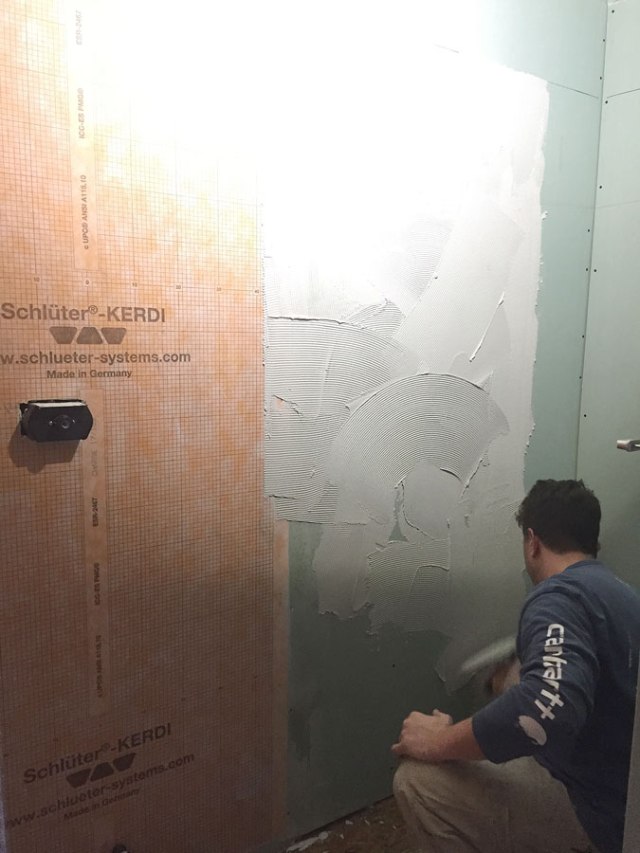
Sean Gundrum, of TPG tile (I think he got tired of me watching him…but the swirls! So pretty!).

Two days ago, my neighbor and expert tile guy Rick Wolf (Wolf Custom Tile), called me late in the day. “We have an opening in the schedule and can be there tomorrow to get started on your shower pan.”

Never start a land war in Asia, never go up against a Sicilian when death is on the line, and never say no to a long-awaited contractor who has an available time slot. So that night, I hurriedly ordered my floor tile. Yesterday, I got a call from the distributor; the tile I want is out of stock, and they are awaiting a shipment. Of course.

I didn’t think it would be a problem to find 1″ porcelain hex tile; it’s quotidian (unlike the hugely expensive 1″ hex soapstone tile that I really wanted…but decided against because, er, full-time freelancer here…). Except that the 1″ porcelain hex tile I wanted apparently isn’t.

I settled on matte tiles in both white and black – not already in a pattern, mind you, because I’m making my own pattern. So the two colors have to be in tiles of the exact same size and sheen, and on a mesh backer rather than that weird “new and better” rubbery stuff some companies are using now to hold mosaic patterns together. (Because that stuff really does hold all the tiles perfectly spaced. Permanently. You can’t pull out individual tiles for pattern needs, except by using a razor knife to cut the stuff then scrape off the residue. No thank you.)

The tile was hard to find – and it will be at least two weeks before it is delivered…by which time the very nice (and professional and neat) guys who were here today (Sean Gundrum and Tore Pastura from TPG Tile; they do a lot of work for Rick) will be on another job.

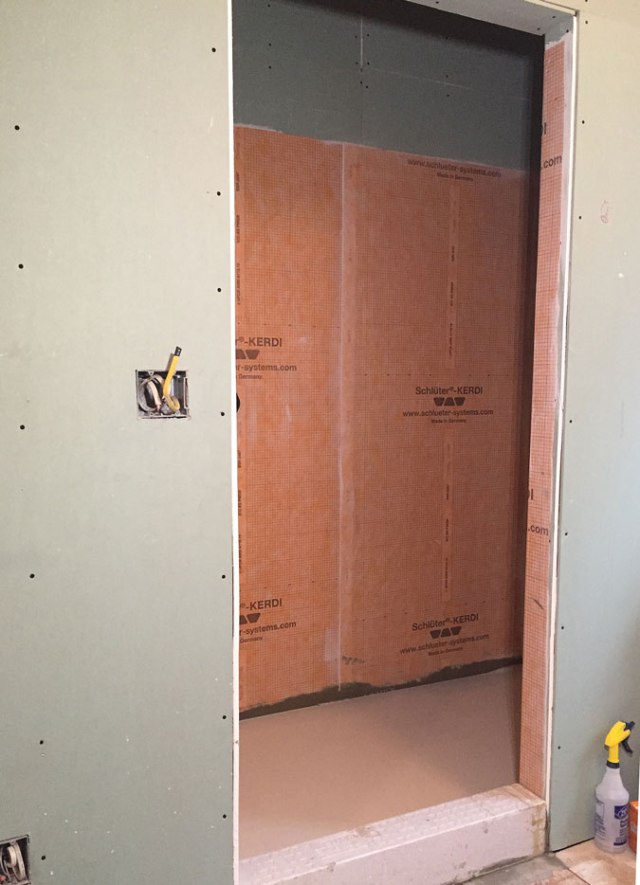
Still, having Schlüter KERDI on the walls and a curb in place is a massive step forward.

Firstdaydone

I’m told that, once the pan is done and the floor tile is in, I don’t actually have to tile the walls to use the shower; this stuff is waterproof. (Still, I think I’ll wait for the wall tile…)

By tomorrow, the self-leveling underlayment will have dried, and they’ll work on the shower pan (also Schlüter), which has to be custom-made (or custom-fit or custom-somethinged, because the shower is a weird size). And they kindly offered to install the HardieBacker in the rest of the bathroom, too, to a) save me the trouble and b) because they’ll have mortar mixed already. That’s awesome – I have no doubt Sean and Tore can do in an hour what would take me a day. Or two.

And hopefully, by the time my floor tile is in and they have room again in their schedule, I’ll have a few more editing or woodworking jobs (or both) lined up – then I can pay them to do all the tile, while I concentrate on my own areas of expertise. Said areas don’t, it seems, include installing a level sub floor.

floor

Yes, yes – the need for a self-leveling layer is a bit embarrassing. But it’s a lot faster than trying to get a level sub floor over a 38″ wide x 8′ long area in a 1906 house in which absolutely nothing is square or level.

Now to keep the cats out of there until it sets up enough…

Posted in Baths, Renovation/Restoration | 9 Comments

Dutch Tool Chest for Sale (No, Not the Exact One Pictured Below)

DTCopen

The inside of Christopher Schwarz’s well-traveled Dutch tool chest


Update: The chest is sold – thank you for your interest. (And keep an eye out for similar items if you’re in the market… I have a few other limbering-up pieces to build in the next few months.)

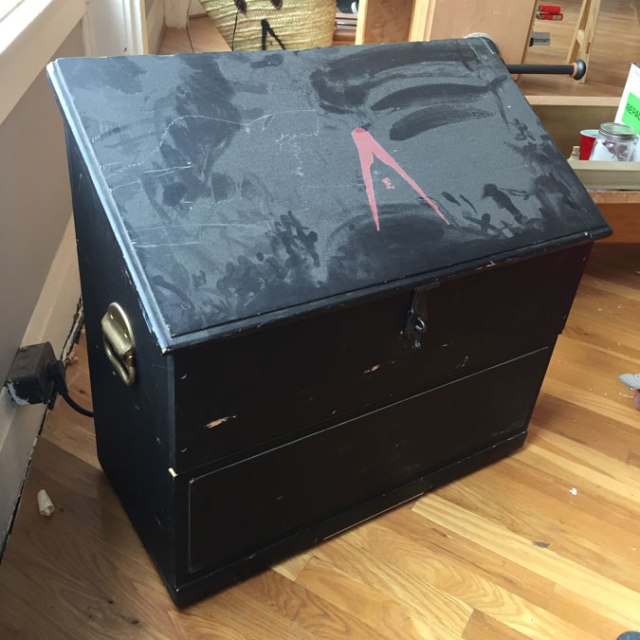
Have you been longing for a Dutch tool chest but don’t have time to make it yourself? Well fret no more. Next week, I’m making one from white pine to limber up for a February class…and I don’t need another tool chest at my house. So I’ll be selling it at a reasonable price (first come, first served), and will paint it per the buyer’s instruction in any of the available colors in the General Finishes Milk Paint collection.

GF

Yes…I will even paint it Coral Crush if you like

I’m making the “small” chest, with dovetailed bottom corners, a single-panel lid (no breadboards) atop the upper compartment and a fall front on the bottom (the same as the one above is configured). The back will be shiplapped. The hinges will be 9-1/2″ x 3-1/2″ unequal strap hinges, and the lifts will be Cast-Iron Chest Handles, both from Lee Valley Tools. The interior will be left for the buyer to configure, based on her or his set of tools. (But I’m happy to toss in an overlong hole-y chisel strip for the buyer to glue in place…after the buyer adjusts the sizes of said holes to fit his or her chisels and other long, pointy items).

The price, built as stated above, is $700, cash, check or PayPal. It goes to the first person to say, “I’ll take it and I’ll come get it” (I’m in Cincinnati, Ohio) or “I’ll take it and I’ll pay for UPS packing and shipping.” If you want it, send me an email at 1snugthejoiner@gmail.com. (Again…send me an email – a comment below won’t do it.)

DTCclosed

Christopher’s DTC, closed. I’d be happy to add a similar layer of dust from the Lost Art Press shop to the one I’m building.

If I don’t find a buyer, I’ll line it with rigid foam insulation, cut a hole in the upper compartment floor, leave off the fall front and make it into a rather expensive and elaborate feral cat shelter.


Posted in Classes, Woodworking | 4 Comments

‘I, one Snug the Joiner…’

Snug_as_Lion_-_Louis_Rhead_(before_1918)

Louis Rhead’s illustration of Snug the Joiner, in his guise as a lion, from an 1918 edition of “Tales of Shakespeare,” by Charles and Mary Lamb.

I get a fair number of questions about my Instagram and Twitter handle, “@1snugthejoiner,” but fewer about the name of this blog,* Rude Mechanicals Press. I think that’s in large part due to Christopher Schwarz using the Twitter handle “@rudemechanic,” and referring to himself as such. As he’s explained many times, a “rude mechanic” is an old term for a skilled laborer, someone who works with his (or her) hands (though in early modern times, it did typically describe men).

Snug is one of the six “rude mechanicals” in William Shakespeare’s “A Midsummer Night’s Dream” a group of craftsmen in Athens who want to put on a play for the city’s royalty, an activity which has its basis in medieval times.

In short, in England (and other countries, but I’m most familiar with English history), from sometime in the 14th century (when the clergy and monks ceded the stage) up until not too long before Shakespeare was born (1564), “theater” consisted solely of “traveling” religious pageants (“mystery plays” or “mystery cycles”) that were acted by a city’s guilds. Each guild would present a pageant within the cycle, and that guild made the props and owned the costumes, and they’d be used year after year.

In the York cycle, for example (one of a handful of cycles that survive almost in their entirety), we know that every year on Corpus Christi day, the Shipwright’s Guild presented the building of the ark, the Goldsmiths staged the “Adoration,” the Bakers’  Guild did the “Last Supper” and the Carpenter’s Guild presented the “Resurrection.” (There are 48 pageants…I won’t bore you with all of them.)

By Shakespeare’s time, plays were no longer restricted to religious topics, and there were a couple professional playhouses and theater companies in London by the time he was an adult. But a group of “rude mechanicals” wanting to stage a play (within a play) would be within living memory for some theater goers, and would be recognized as a quaint, old-fashioned undertaking – ha ha…look at the backward craftsmen! And yes, Shakespeare presented most of his rude mechanicals as just a bit lacking in brains.  They are:

• Nick Bottom, a weaver (he wants to play all the parts, and eventually gets turned into an ass)
• Peter Quince, a carpenter (the group’s leader; he chooses the play “Pyramus and Thisbe,” assigns the roles and delivers the prologue)
• Francis Flute, the bellows mender (he is dismayed to playing a Thisbe, a lady)
• Tom Snout, a tinker (he plays Thisbe’s father…and also portrays a wall, because the group can’t afford to build props)
• Robin Starveling, a tailor (who ends up playing the moon, lantern in hand)
• Snug, a joiner (he plays a lion).

Snug is a little on the slow side, but he’s a kind soul; he’s concerned that the women in the audience will be scared of him in his lion guise:

You, ladies, you, whose gentle hearts do fear
The smallest monstrous mouse that creeps on floor,
May now perchance both quake and tremble here,
When lion rough in wildest rage doth roar.
Then know that I, one Snug the joiner, am
A lion-fell, nor else no lion’s dam;
For, if I should as lion come in strife
Into this place, ’twere pity on my life.” (Scene 5, Act 1) (emphasis mine)

I am a student of Shakespeare, I am a rude mechanical…and at times, I’m a little slow (until I’ve had my morning coffee, at least). Also, a lion is a cat, and I am a semi-crazy cat lady. It seemed a perfect confluence.


* Soon to be more than just a blog – stay tuned!


Posted in Books/Editing/Writing, Rude Mechanicals Press, Uncategorized | 19 Comments

Two More Panels…or Not

drywall

The shower is to the left. Yes, I do still need to run drywall strips around the the door frame and do all the corner beading. And figure out what to do about the gap at the ceiling…which resulted from pulling off the three layers of wallboard that were atop the plaster.

I spent the weekend hanging mold-resistant drywall panels on the non-plastered walls in my bathroom (after hiring a pro to patch and finish-coat the two plaster walls). I can now barely shuffle to the coffee maker and ibuprofen cabinet after two days of running up and down the stairs and ladder. But I had to get it done – Rick Wolf and his team are tentatively scheduled to show up in late January to make the custom-sized shower pan, apply Kerdi to the shower walls and do the tile in there.

I’m fairly brave when it comes to taking on home projects outside my métier…but not so foolish as to think it’s a good idea for me to tackle the job that needs to be water tight. Rick is awfully busy and in high demand, so he’s crazy-difficult to schedule for a small project such as mine. I simply have to be ready whenever he is.

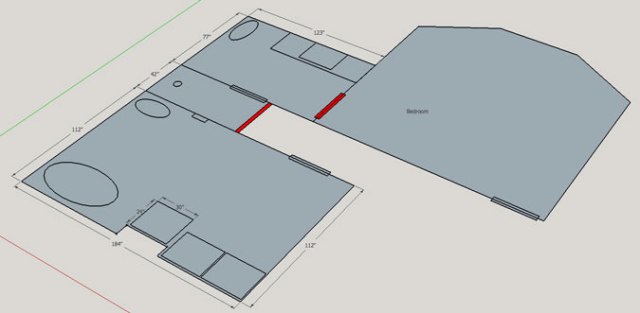
The shower is a 3-1/2′ x 7′-ish space tucked into what used to be a pantry for an apartment kitchen (now the guest and currently only bath) on the backside, and part of a hallway. The door to the shower was formerly the door from said hallway into the bathroom; I cut a new door between my bedroom and the bathroom (and stood in it to take the picture above).

floorplan

Hey – things are starting to actually match the floor plan! The front wall in the narrow hallway used to be about 4″ to the other side of what is now the shower entry (what used to be the bathroom door). It was a long stumble from my bedroom in the middle of the night to that door to use the facilities.

My original plan was to wrap three of the studs in the shower wall with tile, then run glass between them, to allow more natural light into the shower from the bathroom window (there’s an overhead combination light/fan/heat lamp in there, too). But as I took a hard look at the space and my budget on Friday, I changed my mind. That plan would mean a heck of a lot more work for me to deal with the ceiling and floor transitions, and to wrap those studs with drywall. Plus there would be the added expense of the fussy tile work (with copious cuts) and the glass panel installation (as a full-time editing/woodworking hobo, I now have to watch my pennies a bit more closely…not that being a magazine editor was lucrative, you understand, but it was a steady income). Also – and perhaps most mind-swaying – I built a shower with two glass walls at my last house; it was a bitch to keep clean.

So for a number of reasons, I decided to do boring – but easier and far less expensive – flat walls there instead.

But I’d bought only enough drywall for the original plan, and because drywall panels don’t fit in my car, I had to dragoon Christopher Schwarz and his truck to pick it up (as always and for everything, thank you, Chris.)

So I ran out of drywall panels.

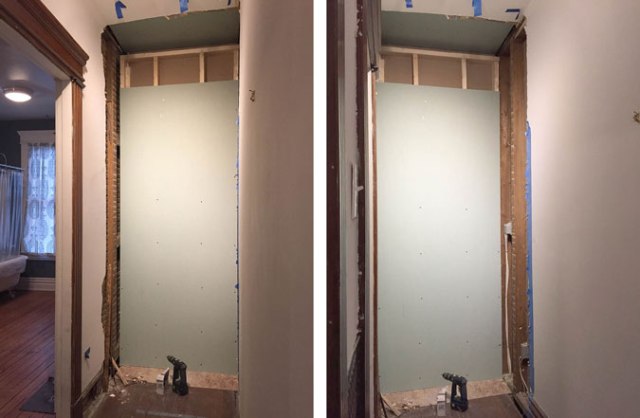
hallway

Deconstructionist. The left-side (left, natch) and right-side views. Note the difference in ceiling levels – there are three (!!) layers of ceiling panels of some kind or another over the original lath and plaster, so what I took down resulted in a good 3″ differential from what I didn’t. But I just don’t have it in me to take down/redo the ceilings throughout.

That lack will in no way affect the shower finishing (whew!), but it looks terrible. I can live with “looks terrible” for a long time…perhaps that’s obvious if you’re a regular reader (I started swinging the sledgehammer on this project on November 9, 2016).

But I’m making a built-in Arts & Crafts-inspired linen cupboard for that space anyway (yay – some actual woodworking!) … so does it really need to have finished walls behind it? I’m going with no. That will give some future owner something to bitch about it when they tear out everything to turn it back into a two-family.

Posted in Baths, Renovation/Restoration, Uncategorized | 6 Comments

Tool List – What to Buy? (Or Wait to Try)

ToolList

With a handful of classes coming up in the near and not-so-near future, I’ve been sending out tool lists. And given that some of the classes are beginner-oriented, I’m getting questions about what specific tools to buy as new-to-woodworking students stock their kits.

Here are the upcoming classes in which there is still room (at last check):
• Dovetailed Silverware Tray Class at Lie-Nielsen Toolworks, Warren, Maine, May 19-20 (caveat – as you’ll see under the workshop listing, Lie-Nielsen of course recommends the products the company makes and/or carries – and they are all very good).

Build a Traditional Traveling Tool Chest, at the Port Townsend School of Woodworking, Port Townsend, Wash., June 4-8.

Now I’m not terribly comfortable telling people how to spend their hard-earned cash (unless you’re thinking of spending it on a class with me – do that!). My tool kit is perforce subject to personal preference; for me, that includes not only how well a tool performs and feels in my hand (though these two considerations are of the utmost importance), but in some cases how it looks (I cannot, for example, resist any blue-handled item that Dave Jeske of Blue Spruce Toolworks offers), and even who made it. (I will always recommend a Tite-Mark cutting gauge over quite similar though less-expensive items because Kevin Drake of Glen-Drake Toolworks came up with the tool – so he gets my money, no matter how many imitations there are, how little they cost and how well they perform…unless they outperform the Tite-Mark, which I’ve yet to experience.)

I’ve used many makes of most hand tools you’d find in a typical furniture maker’s kit, and there are many that are good, even great – yet they aren’t my personal favorites. What appeals to me (for whatever reason) might not appeal to you (for whatever reason). I’d rather people try out a hand tool for themselves if at all possible before making a buying decision.

The above is a long-winded way of excusing what follows: My take-them-with-a-full-shaker-of-salt recommendations for buying new most of the items I’ve put on any recent tool list (and in most cases, why).  Note that I have nothing against vintage tools and have many – it’s just darn-near impossible to source them for a group, because the conditions and numbers available will vary from toolmonger to yard sale to flea market.

Dividers
I think – unless you want to spend semi-serious or serious cash – the “best” dividers are to be found at yard sales, flea markets and other secondhand markets (yes, I know that contradicts what I just said above). So as far as new ones, I like the Starrett 8″ “Toolmakers’ Spring-Type Caliper and Divider” in the “semi-serious cash range,” and in the “serious cash” range, the Crucible Tools “Improved Pattern Dividers.” (Yes, of course I’m biased – but they are excellent and gorgeous.) In the “beyond-serious-but-my-gods-are-they-gorgeous cash” range, get a hand-forged pair from Peter Ross or Seth Gould. (I don’t have these last two…but someday…). And for the second pair (that I like to have on hand for dovetail layout though it’s not strictly necessary), get a small pair of any make.

Cutting or Marking Gauge
Wheel-type Cutting Gauge: Tite-Mark (see above). Traditional Marking Gauge: Hamilton Woodworks.

Dovetail Template
Woodjoy “Precision Dovetail Template.” I have many jigs for dovetail layout and they all work well. But this is one of the first tools I ever bought, so I’m perhaps emotionally attached to it. But it’s both good and inexpensive. (You can, of course, also use a sliding bevel gauge instead – my favorite is from Chris Vesper of Vesper Tools.)

Marking Knife
I have a ridiculous number of marking knives. My favorite is a spear-point knife, from Blue Spruce Toolworks. My second favorite is the Czeck Edge Tools “Kerf Cadet.” My favorite budget knife (and it’s very good – I’m just not fond of a plastic-y handle) is the Veritas “Workshop Striking Knife.”

Dovetail Saw
This one is so very difficult. A dovetail saw should be a good fit for you, and my hands are much smaller than average…which is why I most often reach for my Bad Axe 10″ (15 ppi) saw. One can order from Bad Axe with a semi-custom handle (mine is a “small”). I can’t urge you enough to try out a few different makes before buying a dovetail saw. But if budget is a concern, don’t overlook the Veritas Dovetail saw – it’s very good though non-traditional in appearance, and less than $100 – and the $125 Lie-Nielsen dovetail saws (tapered or not – though I prefer non-tapered) – are very good and traditional in form.

Coping Saw
The last tool I ordered before parting ways with Popular Woodworking was Dave Jeske’s new coping saw (Blue Spruce Toolworks) , after trying it out at a show. Amazing – but not quite yet available. I know I’ll regret some of the money I didn’t save in 2017…but not this. I’ll have to use it a while before seeing if it performs on par with or better than the Knew Concepts coping saw I’ve long loved. For now, the Knew Concepts is my recommendation. (With a little work, though, you can make a hardware store coping saw perform well enough.) Regardless of the saw, kit it out with Pegas blades.

Bevel-edge Chisels
My absolute favorites are a Japanese make that I can never remember (so I had a reminder on my computer at PW that I could look up. Oops.), but I also don’t think they are easily available. So among chisels you can actually get, I like the Lie-Nielsen Bevel-edge Socket Chisels. Get only the ones you need instead of a set, and they won’t be shocking to your wallet.

Mallet
I like the 16-ounce Blue Spruce Toolworks round mallet for chopping out dovetails. I regret to inform you that it is no longer offered in blue.

Crosscut-filed backsaw or panel saw
This one is also difficult; my favorites are vintage and/or no longer available. So among new (and still available) ones, I’d go with the Lie-Nielsen panel saws and the Veritas tenon or carcase saw (I’m inexplicably budget-conscious on these backsaws).

Router Plane
For a large router plane, it’s a toss-up here for me between the Lie-Nielsen and Veritas. The Walke-Moore Tools one is awfully nice looking and I like the idea of the different blade positions, but I’ve not used it enough to weigh in on performance. For a small router plane, I prefer the curved grips on the Lie-Nielsen.

Smooth Plane
Lie-Nielsen, No. 3 (though sometimes the No. 2 and sometimes the No. 4).

Block Plane
I like a small one – one that can fit in an apron (and my hand). I use my Lie-Nielsen No. 102 low-angle block plane most often, but my Veritas sees a lot of use, too (note: the Veritas blade is tapered at the back, so you can’t hold it in an Eclipse-style honing guide).

Rasps
Gramercy rasps from Tools for Working Wood (using their nomenclature, I’d go with the 10″ 16 tpi).  But I’m awfully fond of Auriou rasps, too, which are available from a number of woodworking retailers.

If there’s a tool I’ve not mentioned above, it’s likely because it’s too prosaic and I wouldn’t recommend using other than the one you almost certainly already have (hammer, drill, combination square) or because mine is vintage and that’s what I’d recommend (jack plane, brace, tongue-and-groove plane). Or because I’ve not used enough examples of those currently available to feel comfortable stating a preference, or because you typically have to order the one I’d recommend and wait…and you likely wouldn’t have it in time for the class (wooden rabbet plane, wooden spokeshave).


Posted in Classes, Woodworking | 14 Comments

Playing with Fire

Lido

As you may know from a Lost Art Press event (or at last summer’s Lie-Nielsen open house), I’m always delighted to light a torch and demonstrate shou sugi ban – the Japanese art of charring wood to preserve and protect it.  What can I say…I like playing with fire – but only in a controlled and at least semi-safe environment.

So while editing the translation of Jogge Sundqvist‘s “Slöjd in Wood.” I was interested to read that an accepted practice in Sweden for disposing of linseed oil-laden rags is to burn them.

“Dispose of oily rags properly. In Sweden, we burn rags or soak them in water and put them in a sealed plastic bag. The oxidization process produces heat, so spontaneous combustion of rags or paper is a danger.”

To that, safety-conscious editor that I am, I added, “In the U.S., the accepted practice is to spread them out and hang them to dry. When they are fully dry, throw them away in a lidded, metal trashcan.”

But you know I tried it. (We had to christen the Lost Art Press Lido Deck somehow!)

Turns out linseed oil-impregnated rags burn pretty well.

jogge_interior

“Slöyd in Wood” is due out in early 2018 from Lost Art Press.


Posted in Woodworking | 13 Comments

Bad Case of the Piles

ATC

For about a decade, I had tools in two places. When I began buying nice tools about 12 years ago, I was diligent about taking the ones I needed back and forth between home and the shop at PopWood – why spend money when you don’t have to? But that got to be laborious, so I slipped, and got a second set of chisels. Then another plane or two. And a few more tape measures. And marking gauges. And dovetail saws. And…

Not everything I bought was something I needed. I have the same gut reaction to pretty tools as I have to well-made black boots. I can’t resist them (though I’d best learn). The first really good tool I ever bought was a marking knife from Dave Jeske at Blue Spruce Toolworks. I still have it and use it on almost every project. But two years ago, Dave showed me his then-new marking knife system with interchangeable blades. Never mind that I already had three other nice marking knives and a handful of variously tipped awls. The handle he showed me was of blue infused resin. It is now mine.

Then I bought a Lie-Nielsen Toolworks No. 4. Again, I used it on almost every project. Until I bought a No. 3 about 18 months ago; it fits a little better in my hand…but I simply cannot get rid of the No. 4.

And Glen-Drake Tite-Marks. My goodness do I have a lot of Tite-Marks. But one can never have too many. (They’re not all the same size, and one has the mortise blades on it…so they don’t count as duplicates!)

small-chest

But I do have far too many tools. My home kit is fairly well arranged in my beloved Anarchist’s Tool Chest*, shown at the top. The rest – those I brought home from the office – are scattered throughout the kitchen, dining room and basement in various boxes and bags. Of the many containers I brought home, only my small tool chest shows a modicum of organization…at best.

DiningRoom

What…you don’t keep a miter box and grinder in your dining room?

basement-table

Mostly a mystery pile…alongside several lighting projects.

basementbags

Unfinished projects, a couple saws, marking gauges…and who knows what.

Today, I am attempting to go through everything and re-integrate into my ATC the few tools that did travel back and forth, set aside the duplicates with which I know simply can’t bear to part (and a few that were loans, and that will be returned to their makers), and think about selling the remainder. I imagine it will take me a while to get around to actually selling them, but…baby steps.

* Note: I’m teaching a class in building a traveling (read, slightly smaller) iteration of the “Anarchist’s Tool Chest” June 4-8 at the Port Townsend School of Woodworking, in Port Townsend, Washington. Registration is now open.

Posted in Woodworking | 8 Comments