Dutch Tool Chest for Sale (No, Not the Exact One Pictured Below)

DTCopen

The inside of Christopher Schwarz’s well-traveled Dutch tool chest


Update: The chest is sold – thank you for your interest. (And keep an eye out for similar items if you’re in the market… I have a few other limbering-up pieces to build in the next few months.)

Have you been longing for a Dutch tool chest but don’t have time to make it yourself? Well fret no more. Next week, I’m making one from white pine to limber up for a February class…and I don’t need another tool chest at my house. So I’ll be selling it at a reasonable price (first come, first served), and will paint it per the buyer’s instruction in any of the available colors in the General Finishes Milk Paint collection.

GF

Yes…I will even paint it Coral Crush if you like

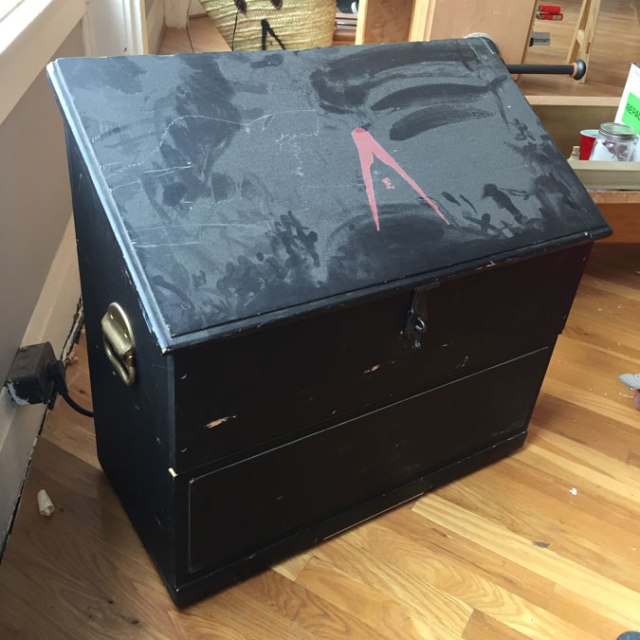
I’m making the “small” chest, with dovetailed bottom corners, a single-panel lid (no breadboards) atop the upper compartment and a fall front on the bottom (the same as the one above is configured). The back will be shiplapped. The hinges will be 9-1/2″ x 3-1/2″ unequal strap hinges, and the lifts will be Cast-Iron Chest Handles, both from Lee Valley Tools. The interior will be left for the buyer to configure, based on her or his set of tools. (But I’m happy to toss in an overlong hole-y chisel strip for the buyer to glue in place…after the buyer adjusts the sizes of said holes to fit his or her chisels and other long, pointy items).

The price, built as stated above, is $700, cash, check or PayPal. It goes to the first person to say, “I’ll take it and I’ll come get it” (I’m in Cincinnati, Ohio) or “I’ll take it and I’ll pay for UPS packing and shipping.” If you want it, send me an email at 1snugthejoiner@gmail.com. (Again…send me an email – a comment below won’t do it.)

DTCclosed

Christopher’s DTC, closed. I’d be happy to add a similar layer of dust from the Lost Art Press shop to the one I’m building.

If I don’t find a buyer, I’ll line it with rigid foam insulation, cut a hole in the upper compartment floor, leave off the fall front and make it into a rather expensive and elaborate feral cat shelter.


Posted in Classes, Woodworking | 4 Comments

Tool List – What to Buy? (Or Wait to Try)

ToolList

With a handful of classes coming up in the near and not-so-near future, I’ve been sending out tool lists. And given that some of the classes are beginner-oriented, I’m getting questions about what specific tools to buy as new-to-woodworking students stock their kits.

Here are the upcoming classes in which there is still room (at last check):
• Dovetailed Silverware Tray Class at Lie-Nielsen Toolworks, Warren, Maine, May 19-20 (caveat – as you’ll see under the workshop listing, Lie-Nielsen of course recommends the products the company makes and/or carries – and they are all very good).

Build a Traditional Traveling Tool Chest, at the Port Townsend School of Woodworking, Port Townsend, Wash., June 4-8.

Now I’m not terribly comfortable telling people how to spend their hard-earned cash (unless you’re thinking of spending it on a class with me – do that!). My tool kit is perforce subject to personal preference; for me, that includes not only how well a tool performs and feels in my hand (though these two considerations are of the utmost importance), but in some cases how it looks (I cannot, for example, resist any blue-handled item that Dave Jeske of Blue Spruce Toolworks offers), and even who made it. (I will always recommend a Tite-Mark cutting gauge over quite similar though less-expensive items because Kevin Drake of Glen-Drake Toolworks came up with the tool – so he gets my money, no matter how many imitations there are, how little they cost and how well they perform…unless they outperform the Tite-Mark, which I’ve yet to experience.)

I’ve used many makes of most hand tools you’d find in a typical furniture maker’s kit, and there are many that are good, even great – yet they aren’t my personal favorites. What appeals to me (for whatever reason) might not appeal to you (for whatever reason). I’d rather people try out a hand tool for themselves if at all possible before making a buying decision.

The above is a long-winded way of excusing what follows: My take-them-with-a-full-shaker-of-salt recommendations for buying new most of the items I’ve put on any recent tool list (and in most cases, why).  Note that I have nothing against vintage tools and have many – it’s just darn-near impossible to source them for a group, because the conditions and numbers available will vary from toolmonger to yard sale to flea market.

Dividers
I think – unless you want to spend semi-serious or serious cash – the “best” dividers are to be found at yard sales, flea markets and other secondhand markets (yes, I know that contradicts what I just said above). So as far as new ones, I like the Starrett 8″ “Toolmakers’ Spring-Type Caliper and Divider” in the “semi-serious cash range,” and in the “serious cash” range, the Crucible Tools “Improved Pattern Dividers.” (Yes, of course I’m biased – but they are excellent and gorgeous.) In the “beyond-serious-but-my-gods-are-they-gorgeous cash” range, get a hand-forged pair from Peter Ross or Seth Gould. (I don’t have these last two…but someday…). And for the second pair (that I like to have on hand for dovetail layout though it’s not strictly necessary), get a small pair of any make.

Cutting or Marking Gauge
Wheel-type Cutting Gauge: Tite-Mark (see above). Traditional Marking Gauge: Hamilton Woodworks.

Dovetail Template
Woodjoy “Precision Dovetail Template.” I have many jigs for dovetail layout and they all work well. But this is one of the first tools I ever bought, so I’m perhaps emotionally attached to it. But it’s both good and inexpensive. (You can, of course, also use a sliding bevel gauge instead – my favorite is from Chris Vesper of Vesper Tools.)

Marking Knife
I have a ridiculous number of marking knives. My favorite is a spear-point knife, from Blue Spruce Toolworks. My second favorite is the Czeck Edge Tools “Kerf Cadet.” My favorite budget knife (and it’s very good – I’m just not fond of a plastic-y handle) is the Veritas “Workshop Striking Knife.”

Dovetail Saw
This one is so very difficult. A dovetail saw should be a good fit for you, and my hands are much smaller than average…which is why I most often reach for my Bad Axe 10″ (15 ppi) saw. One can order from Bad Axe with a semi-custom handle (mine is a “small”). I can’t urge you enough to try out a few different makes before buying a dovetail saw. But if budget is a concern, don’t overlook the Veritas Dovetail saw – it’s very good though non-traditional in appearance, and less than $100 – and the $125 Lie-Nielsen dovetail saws (tapered or not – though I prefer non-tapered) – are very good and traditional in form.

Coping Saw
The last tool I ordered before parting ways with Popular Woodworking was Dave Jeske’s new coping saw (Blue Spruce Toolworks) , after trying it out at a show. Amazing – but not quite yet available. I know I’ll regret some of the money I didn’t save in 2017…but not this. I’ll have to use it a while before seeing if it performs on par with or better than the Knew Concepts coping saw I’ve long loved. For now, the Knew Concepts is my recommendation. (With a little work, though, you can make a hardware store coping saw perform well enough.) Regardless of the saw, kit it out with Pegas blades.

Bevel-edge Chisels
My absolute favorites are a Japanese make that I can never remember (so I had a reminder on my computer at PW that I could look up. Oops.), but I also don’t think they are easily available. So among chisels you can actually get, I like the Lie-Nielsen Bevel-edge Socket Chisels. Get only the ones you need instead of a set, and they won’t be shocking to your wallet.

Mallet
I like the 16-ounce Blue Spruce Toolworks round mallet for chopping out dovetails. I regret to inform you that it is no longer offered in blue.

Crosscut-filed backsaw or panel saw
This one is also difficult; my favorites are vintage and/or no longer available. So among new (and still available) ones, I’d go with the Lie-Nielsen panel saws and the Veritas tenon or carcase saw (I’m inexplicably budget-conscious on these backsaws).

Router Plane
For a large router plane, it’s a toss-up here for me between the Lie-Nielsen and Veritas. The Walke-Moore Tools one is awfully nice looking and I like the idea of the different blade positions, but I’ve not used it enough to weigh in on performance. For a small router plane, I prefer the curved grips on the Lie-Nielsen.

Smooth Plane
Lie-Nielsen, No. 3 (though sometimes the No. 2 and sometimes the No. 4).

Block Plane
I like a small one – one that can fit in an apron (and my hand). I use my Lie-Nielsen No. 102 low-angle block plane most often, but my Veritas sees a lot of use, too (note: the Veritas blade is tapered at the back, so you can’t hold it in an Eclipse-style honing guide).

Rasps
Gramercy rasps from Tools for Working Wood (using their nomenclature, I’d go with the 10″ 16 tpi).  But I’m awfully fond of Auriou rasps, too, which are available from a number of woodworking retailers.

If there’s a tool I’ve not mentioned above, it’s likely because it’s too prosaic and I wouldn’t recommend using other than the one you almost certainly already have (hammer, drill, combination square) or because mine is vintage and that’s what I’d recommend (jack plane, brace, tongue-and-groove plane). Or because I’ve not used enough examples of those currently available to feel comfortable stating a preference, or because you typically have to order the one I’d recommend and wait…and you likely wouldn’t have it in time for the class (wooden rabbet plane, wooden spokeshave).

Posted in Classes, Woodworking | 14 Comments

Playing with Fire

Lido

As you may know from a Lost Art Press event (or at last summer’s Lie-Nielsen open house), I’m always delighted to light a torch and demonstrate shou sugi ban – the Japanese art of charring wood to preserve and protect it.  What can I say…I like playing with fire – but only in a controlled and at least semi-safe environment.

So while editing the translation of Jogge Sundqvist‘s “Slöjd in Wood.” I was interested to read that an accepted practice in Sweden for disposing of linseed oil-laden rags is to burn them.

“Dispose of oily rags properly. In Sweden, we burn rags or soak them in water and put them in a sealed plastic bag. The oxidization process produces heat, so spontaneous combustion of rags or paper is a danger.”

To that, safety-conscious editor that I am, I added, “In the U.S., the accepted practice is to spread them out and hang them to dry. When they are fully dry, throw them away in a lidded, metal trashcan.”

But you know I tried it. (We had to christen the Lost Art Press Lido Deck somehow!)

Turns out linseed oil-impregnated rags burn pretty well.

jogge_interior

“Slöyd in Wood” is due out in early 2018 from Lost Art Press.


Posted in Woodworking | 13 Comments

Bad Case of the Piles

ATC

For about a decade, I had tools in two places. When I began buying nice tools about 12 years ago, I was diligent about taking the ones I needed back and forth between home and the shop at PopWood – why spend money when you don’t have to? But that got to be laborious, so I slipped, and got a second set of chisels. Then another plane or two. And a few more tape measures. And marking gauges. And dovetail saws. And…

Not everything I bought was something I needed. I have the same gut reaction to pretty tools as I have to well-made black boots. I can’t resist them (though I’d best learn). The first really good tool I ever bought was a marking knife from Dave Jeske at Blue Spruce Toolworks. I still have it and use it on almost every project. But two years ago, Dave showed me his then-new marking knife system with interchangeable blades. Never mind that I already had three other nice marking knives and a handful of variously tipped awls. The handle he showed me was of blue infused resin. It is now mine.

Then I bought a Lie-Nielsen Toolworks No. 4. Again, I used it on almost every project. Until I bought a No. 3 about 18 months ago; it fits a little better in my hand…but I simply cannot get rid of the No. 4.

And Glen-Drake Tite-Marks. My goodness do I have a lot of Tite-Marks. But one can never have too many. (They’re not all the same size, and one has the mortise blades on it…so they don’t count as duplicates!)

small-chest

But I do have far too many tools. My home kit is fairly well arranged in my beloved Anarchist’s Tool Chest*, shown at the top. The rest – those I brought home from the office – are scattered throughout the kitchen, dining room and basement in various boxes and bags. Of the many containers I brought home, only my small tool chest shows a modicum of organization…at best.

DiningRoom

What…you don’t keep a miter box and grinder in your dining room?

basement-table

Mostly a mystery pile…alongside several lighting projects.

basementbags

Unfinished projects, a couple saws, marking gauges…and who knows what.

Today, I am attempting to go through everything and re-integrate into my ATC the few tools that did travel back and forth, set aside the duplicates with which I know simply can’t bear to part (and a few that were loans, and that will be returned to their makers), and think about selling the remainder. I imagine it will take me a while to get around to actually selling them, but…baby steps.

* Note: I’m teaching a class in building a traveling (read, slightly smaller) iteration of the “Anarchist’s Tool Chest” June 4-8 at the Port Townsend School of Woodworking, in Port Townsend, Washington. Registration is now open.

Posted in Woodworking | 8 Comments

Slöjd in Slippers

Day-1

Today, I’m diving into the Woodworking Hobo Life, copy editing in my sweatpants and slippers. I might shower. I might not. The cats seem pretty happy – they can now beg me for treats and canned food 24/7.

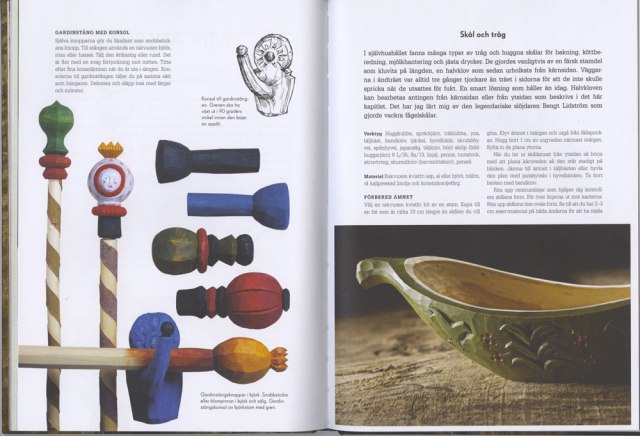
I’m working on the forthcoming Lost Art Press translation of Jögge Sundqvist’s seminal book “Slöjda/Slöjd/Sloyd on Wood.” (I suppose the first order of business is to decide whether it’s “slöjda,” “slöjd” or “sloyd” … I think “slöjd” is the winner.)

What is slöjd? Jogge writes:

Slöjd is part of the self-sufficient household, how people survived before industrialization. Slöjd is the work methods that farmers used when they made tools for house building, farming and fishing, and objects for their household needs. For thousands of years, the knowledge of the material has deepened, and the use of the tools has evolved along with the understanding of how function, composition and form combine to make objects strong and useful.”

LAP acquired the rights a couple years back, and the book is now translated, edited and refined. What’s left on the “words” front is to consider the comments from the various editors and Jogge’s responses, decide on the final language then copy edit.

The book is already in an InDesign document (the translation will look like the original, with gorgeous photos and illustrations), so after the copy edit, I simply have to flow in the English text, make sure page numbers and captions are correct, and that all names/dates/web addresses have been double-checked…all the nitty-gritty before it goes to press. I love the nitty-gritty. I think you’re going to love this book. And I think I’m going to love working in my slippers.


Posted in Personal Favorites | 22 Comments

Dovetail Class Kit to the Baking Rescue

toothpicksYesterday, I reached into the cabinet for toothpicks so I could test the cake doneness for my annual Thanksgiving dinner dessert, a raspberry and marsala trifle. But I was out of toothpicks. Eek! Then I remembered I have some in my tool chest – they’re part of my “dovetail fixes kit” for a class I give on the subject, coupled with a bunch of pictures of period dovetails that look like crap but have held a joint together for 100+ years. In short, my primary message is that if your dovetails aren’t altogether Krenovian: Live with it; the build will (likely) stay together.

But if you simply must fix an “error,” read on.

“Cabinetmakers have been hiding dovetail mistakes from rich people for centuries.”
— the guy who taught Schwarz to cut dovetails

“Everyone who has ever cut a dovetail has &*%^ed up a dovetail.”
— Me & everyone else who’s ever talked about the joint

Baseline “Error” Fixes
1. Try to clamp it out. Put blocks on the tails, squirt a runny glue in there (white glue, West System epoxy) then clamp the snot out of it.
2. Bishoping (works only if the tails/pins are a bit proud). Wet the tail/pin, then tap gently with ball-peen hammer to mushroom it a little. Don’t peen below carcase surface.
3. Controlled spelching. That is, use a block plane to plane toward the baseline to consciously break out a bit of the grain to fill the gap(s).
4. White glue & sandpaper (while the glue is wet).
5. For big gaps, glue in shims, then flush after glue is dry.
6. Fix with Durham’s Water Putty, then paint.
7. Live with it; the build will (likely) stay together.

Splay “Error” Fixes
1. Kerf through middle of tail/pin then wedge it in the kerf. (Use contrasting wood and call it a design feature.)
2. Wedge the gaps.
3. Fix with Durham’s Water Putty, then paint.
4. Live with it; the build will (likely) stay together.

(Other) Errant Sawing Fixes
1. Cross the baseline? Glue in a flat or round toothpick. Flush. Color w/Sharpie.
2. Bite into a pin or tail while coping? See above.
3. Saw on the wrong side of your line? Squeeze yellow glue into the joint (floss can help) and tape it tightly to the adjacent wood. Let it dry, re-mark the cut, then cut again…on the correct side of the line.
4. Live with it; the build will (likely) stay together.

Assembly “Error” Fix
1. Crushed tail corner? Glue in a flat or round toothpick. Flush. Color w/Sharpie.
3. Live with it; the build will stay (likely) together.

trifle

Note: Ignore what the recipe says about one cake; always make two … you’ll need at least three more slices than can reasonably had from but one. And the extra makes a delightful Thanksgiving day breakfast.


Posted in Woodworking | 9 Comments

Opinions Are Like Assh…

plaster

I’ve spent a frustrating couple of hours researching how best to adhere tile on plaster walls that are in decent shape…or will be shortly, after I’ve scraped off the loose bits of adhesive that was holding the hardboard in place, to which was attached some nasty plastic tile in several spots, over which was glued Kelly-green beadboard. (Then maybe do a few brown-coat patches.)

I have been in countless old homes that were built pre-drywall/cement board/Kerdi board that not only have original plaster walls, but original tile on said plaster walls. Hell – there are mosaics set in plaster that have survived for 2,000+ years. Under water.

The internet is full of opinions – but even those from recognized experts are contradictory.

“No! You MUST secure Kerdi board/drywall/cement board to the studs and tile to that!” Um, no. There are no studs. It’s solid masonry.

“Yes! Just paint it first with RedGard.”

“Yes – but whatever you do, don’t paint it with RedGard!”

“No! You must remove all the old plaster down to the brick, then install lathe and hang drywall to that.” No effin way.

“Yes – but don’t use/only use thinset.”

“Yes – but don’t use/only use mastic.”

“Yes, but only if you use mastic you’ve rendered yourself from Pistacia lentiscus.

“You fool. Don’t you know the correct term is Ceramic tile adhesive?!”

“No. You should just move.”


Posted in Baths, Personal Favorites, Renovation/Restoration | 6 Comments

Please Pardon the Mess

dining-room

Is there any renovation project that doesn’t spill into the entire house? Not in my experience.

Though the bathrooms on which I’m currently working are on the second floor, I had to tear out the back wall of the pantry to get to the plumbing and run new electric. So most of the crap that was in the pantry is now on the dining room table, around which will be gathered 10 or so friends on Thanksgiving.

There’s no sense in re-building the pantry over the weekend; it’s going to become a small powder room when I get around to renovating the kitchen. And the current first-floor bath will turn back into its original form – a butler’s pantry.

That first floor bath is the one with a leaky tub – but it can hold a few boxes, and flats of soda, right? (I’ll simply re-hang the shower curtain to hide the mess.)

But I really should hang the door on the new guest bath…soon. Or at least hang a curtain.


Posted in Baths, Renovation/Restoration | 5 Comments

One Step Up & Two…Well, You Know

triminstalled

Per my last post, I set a deadline of Nov. 9 for finishing the guest bath. That was stupid.

But I’m getting close.

Over the last two days, I mitered, fit, painted and installed the 30 pieces of base moulding (it’s a three-part buildup). That was fun, what with having to run up and down to the basement two floors below to cut every piece…then run up and down again to tweak most of them. I need a larger miter box or a lighter chop saw (but I also need the exercise, so I guess it was beneficial?).

It took a bit longer than it might because there is nowhere in my house where I can paint said 30 pieces all at once, so I had to do it in shifts – and of course, because this was bare moulding, it needed multiple coats, with sanding in between. So that was most of one day.

trimpainting

I think this was the second shift.

My plan for today was to install the window trim – on one of the windows, anyway. On the other, the seal isn’t tight, and with the first heavy rain after it was installed, water got into the bottom rail. That was months ago. I’m still awaiting the promised replacement (and becoming increasingly irked). So while I’m going to wait on that one (it will be easier to replace without the sill installed), I figured I could finish the other and have things at least closer to done.

Well, except for the hole in the ceiling around the exhaust fan. I can’t fix that until the fan is operational, and that can’t happen until my roofer can fit me in to run the exhaust vent through the roof. And I can then get the electrician back over to hook it up.

But today, I am the problem. I cut and moulded the window sills maybe a month ago, measuring the window plus two times the width of the fluted trim that abuts it, plus another inch on either side. Then I chanced upon salvaged aprons and returns that match those in the rest of my house, which saved me the trouble of making said pieces (they’re complex mouldings, so I was delighted). But oops. They’re slightly different in size than what I’d measured.

window

If only I’d added 2″…

So I have to remake the sills. And to do that, I have to go buy more Southern yellow pine, then go into the shop at work.

Nope; not today. I think I’ll install the outlet and switch plate covers, then curl up with a book. After leaving yet another message for my window maker and roofer.

Posted in Baths, Renovation/Restoration | 5 Comments

A Vow I Might Regret (& Possibly Break)

BATHTRIM

I ran out of room on my sawbenches – ladder to the rescue!

After a summer filled with travel, teaching, fun and family visits (and the day job, of course), I’ve finally the time to get back to work on the guest bathroom. I vow it will be completely done by November 9 – one year to the day I picked up my sledge hammer and started swinging at the walls.

Today, I sanded down the raised grain and fuzzy patches left by dip-stripping the original trim I’d unearthed in the garage, then I got out the paint and brush. Why, you might ask, did I bother to have it stripped just to again paint it? There were enough layers of (probably lead-based) paint to obscure the details. Plus, I figured the chemicals would kill any wee beasties hiding inside.

At work, I’ve already moulded (by router) the ogee edges of the two stools (the decorative piece that goes atop the sill to butt up to the window’s lower rail); this week, I’ll pull out the moulding planes to replicate the fairly fancy trim that wraps the top of the aprons (the bit that goes under the stool) to match those in the rest of the house, and to shape the aprons’ bottom edges. (Easier, cheaper and more efficient to use the hand tools I already have than to try to find (and buy) the necessary router bits.)

stool

Replicating this will be a bit of a challenge.

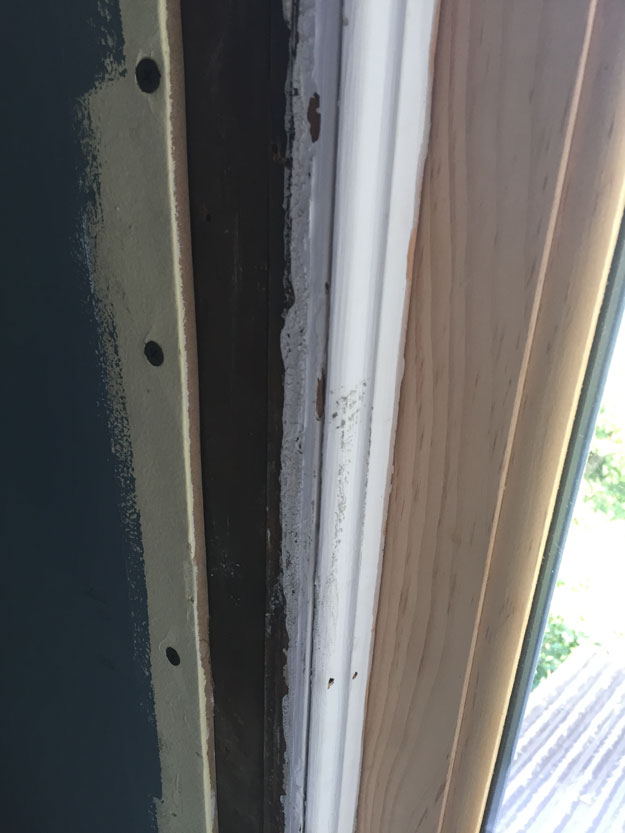
Before I can install the trim, however, I have to get creative to overcome some remuddling. The bathroom walls have 1/8″ drywall (yes – 1/8″; no wonder the walls are curvaceous) over the plaster, and it stops a couple inches short of the window casing. As a result, the wall protrudes 1/8″ farther than the casing to which the trim must be nailed. That will cause problems a) with the trim sitting level to the wall, and b) with properly installing the window stops (oh yeah…gotta make those, too). So, I have to run about 37′ of 1/8″ x 2″ (or so) of something to install flush to the casing before I can install the trim. And I’ll have to scrape the casing first, to boot.

BATHWALL

How very vexing. (Those are, BTW, temporary stops)

The biggest challenge by far, though (with the plumbing now out of the way) will be the base moulding. It’s an 8-1/2″-wide multi-part undulating design that’s going to be a pain in the keister to make – so once I decide how I’m going to do it and get the tooling dialed in, I’ll run scores extra feet thereof for places in the house where it’s missing, and for the kitchen remodel to come. (After a year of haunting architectural salvage stores and sites, it has become painfully clear the only way forward is to sneck up and make it.)

base

Replicating this will be more than a bit of a challenge. Also, I need a new vacuum cleaner…and someone to run it.

But tomorrow, my plumber is coming to put in the sink shut-off valves and drain – so I’ll finally, after one year, once again have a full suite of working bathroom fixtures in one room! Plus, he’s going to install the mixing valve and run the pipe beyond it for the shower head in my walk-in shower – so I’ll finally be able to move forward with that project as well!

And by now the first coat of paint is probably dry. Time for coat two.

Posted in Baths, Renovation/Restoration | 7 Comments